
Most people come to us with an application, not a part list. They don’t open with “I need a 100KV motor”. They say something like “we spray 200 acres a week” or “we’ve got 40km of line to check” or “the surveyor wants 2cm accuracy”. That’s the right way round to think about it.
Quick answer: Work backwards from the job, not from a part number. Agriculture is the heaviest of the four: a 10L tank is 10kg of liquid that moves, and with frame, pump, nozzles, flow sensors and pack a small spray drone lands at 40kg or more, which is why the P60 and P80 class motors swing 28-30 inch props at 12S and 14S. Inspection is about time in the air, with 20-35 minute sorties. Survey is about accuracy, with RTK and a 2cm target. Delivery splits at about 30kg, above which a VTOL beats a bigger hexacopter because cruise costs far less than hover. A single multirotor lifts around 30kg comfortably. See our motor selection guide and the agricultural setup guide.
| Application | What decides the hardware | Reference numbers | Guide |
|---|---|---|---|
| Agriculture | Tank volume, sealing and dust | 10L tank = 10kg; 40kg+ all up; P60/P80 at 12S-14S | Agricultural setup |
| Inspection | Time in the air | 20-35 minute sorties | Line inspection |
| Survey | Accuracy | 2cm target, 75-80% forward overlap | Survey and mapping |
| Delivery | Payload class | Under 30kg multirotor, above 30kg VTOL | Delivery drone classes |
So this page works backwards from the job. What is the aircraft actually doing all day? How heavy is the thing it has to lift? How long does it have to stay in the air? Once you answer those three, the motor, the propeller, the pack and the radio sort of fall out of it. Get them the wrong way round and you end up with a machine that flies fine on paper and disappoints you in a field.
We sell propulsion, batteries and avionics, so that’s the angle here. If you want the component-level detail, the three pillar guides are motor, ESC and propeller, battery sizing and control, video, RTK and gimbal. This page is about how those three meet the actual work.
What really changes from one job to the next
The airframe often looks similar. A six-rotor industrial drone is a six-rotor industrial drone. What changes is payload weight, how the weight is carried, and how long a single sortie has to last. A spray drone hauls a sloshing tank. An inspection drone hangs a gimbal off the nose and hovers almost still for twenty minutes. A mapping drone flies a fixed grid at a steady speed and cares about where it is to the centimetre. Same frame family, three different set-ups.
Two numbers drive almost every decision. The first is all-up weight, because thrust has to beat it with margin. The second is hover current, because that’s what sets your flight time and the size of your ESC. Everything else, KV, prop diameter, cell count, C-rating, is downstream of those two.
Agriculture: the heaviest job of the four
Spray drones carry the most and work the hardest. A 10L tank is 10kg of liquid that shifts around as you turn, and it sloshes in a way that a camera never does. Then you add the pump, the nozzles, the flow sensors and the frame, and a “small” agricultural drone lands at 40kg or more all up.
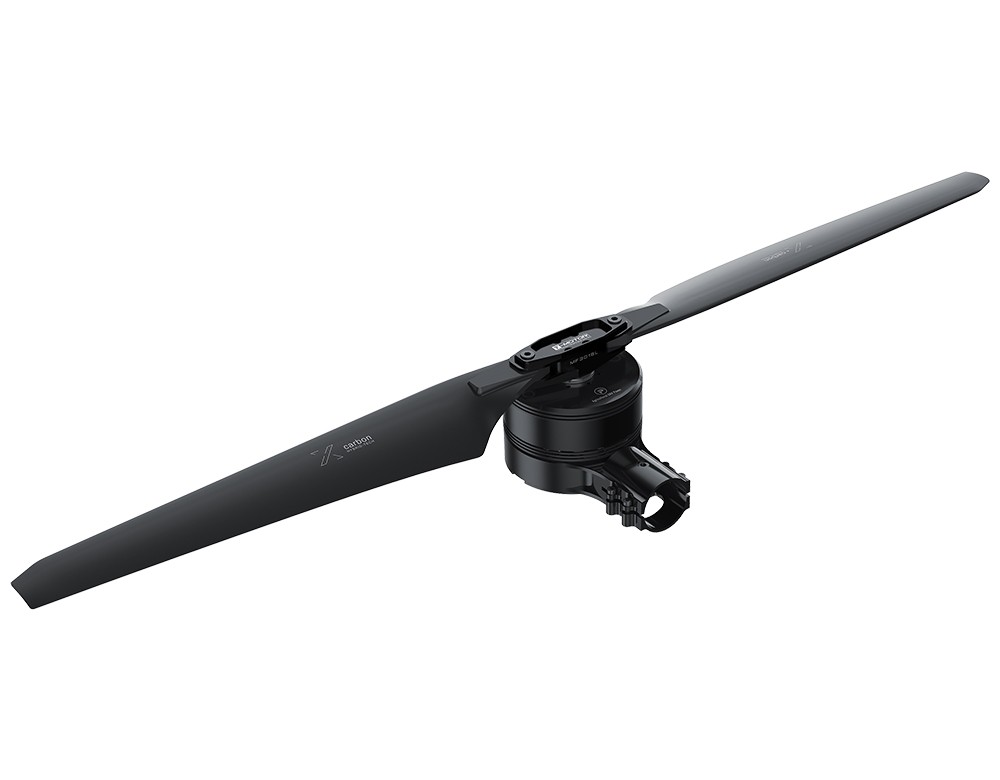
That pushes you towards lower KV motors, big propellers and high cell counts. The P-type agricultural motors exist for exactly this: P60 and P80 class motors are built to swing 30 inch props at 12S and 14S, and the sealed bearings and coating matter because spray drift eats bearings for breakfast.
Battery is the other half. Cell count sets the voltage you can run, capacity sets how many hectares per sortie. The full walk-through on picking a pack by tank size and ROI is in our agricultural drone battery selection guide. And if you want the component choices line by line, that’s the agricultural drone set-up article.
Inspection: it’s about time in the air, not payload
Inspection is the opposite problem. The payload is light, a gimbal and a camera, maybe 1kg or 2kg. What kills an inspection mission is time. You have a line to walk, a tower to circle, a roof to scan, and if the drone lands early you get half the job and go back tomorrow.
That means efficient propulsion at a low, steady hover, and a pack sized for the whole route rather than a sprint. Thermal is usually the lead sensor for anything electrical or mechanical, because a hot joint or a dry bearing shows up in the thermal image long before it fails. We cover the sensor side in thermal vs zoom gimbal cameras, and the practical set-up, endurance targets included, in power line inspection set-up.
Survey and mapping: it’s about being accurate, not fast
Mapping drones fly slow, high and level. The camera fires on a trigger, the overlaps have to line up, and every shot needs to know where it was taken. Get the position wrong and the map is soft, and a soft map is a re-fly.
This is where RTK earns its keep. With corrections coming in, you stop relying on ground control points for every flight and the model comes out consistent. Base station or network corrections, that choice is in base vs network RTK, and the full configuration is in survey and mapping drone configuration.
Delivery and logistics: payload class decides everything
Delivery splits sharply by weight. A 2kg parcel is a big multirotor with a release mechanism. A 50kg payload is a different aircraft entirely, and at that weight you’re usually looking at a VTOL so the range isn’t eaten by hovering. From 30kg up, thrust margin, pack energy and airframe weight all start to fight each other.
We run that split class by class in delivery and logistics by payload class. If you’re at the heavy end, the lift motors and props are covered in heavy lift drone motors and the carbon props live under UAV carbon fibre propellers.
The set-up each job tends to need
Agriculture
Low KV motors, 28-30 inch props, 12S or 14S packs with real capacity, sealed bearings, and avionics that can handle spray controllers and flow sensors. Start with the P80-X combo pack or the A16L-24S modular system if you’d rather have the matching done for you.
Inspection
Mid KV motors for a quiet, efficient hover, large slow props, a long-endurance pack, and a stabilised gimbal with thermal. Look at multi-rotor UAV motors for the lift and avionics for the gimbal and downlink.
Survey and mapping
Efficient cruise, RTK on board, a global-shutter camera, and enough pack to cover the grid in one go. The modular propulsion systems give you a clean, repeatable hover, which is what a clean map needs.
Delivery
From 30kg up it’s VTOL territory, with VTOL motors and pusher props, or a heavy multirotor with the U15XXL class combo at the very top. Release systems sit under logistics systems.
How to spec it without guessing
Write down the payload, the all-up weight, the flight time you need and the highest altitude and wind you’ll work in. Then work in this order: total thrust, thrust per motor, cell count, the thrust table at that voltage, hover current, ESC rating, propeller size, then the pack. Skip a step and you’ll usually find the gap later, in the air.
One more thing that saves a lot of money. Decide your battery chemistry early. A pack you chose for a 12S spray drone won’t suit a 24S heavy lifter, and buying the motors before you’ve settled the pack is the most common way to paint yourself into a corner.
Frequently asked questions
Can I use the same drone for spraying and surveying?
You can, but it is a compromise. Spray drones are set up for weight and sealing; survey drones are set up for accuracy and camera triggers. Most operators who do both keep two airframes rather than rebuild one twice a week, which is the split in our agricultural setup guide.
How much flight time should I plan for?
Plan for the job, not the maximum. If the route needs 18 minutes, size the pack for 22 and land with margin. Running to the last cell costs you packs and nerve.
Do I need RTK for agricultural work?
Usually not for spraying. GPS with good satellite lock is fine for coverage. RTK matters when the map itself has to be right, which is survey and often inspection, as our RTK guide explains.
What payload can a single multirotor realistically lift?
Up to around 30kg comfortably with the right motors and props. Past that efficiency falls off and a VTOL usually makes more sense than a bigger hexacopter, which is the logic in our heavy-lift motor guide.
Where should I start if I only know the job?
Tell us the payload, the all-up weight and the flight time. Those three narrow the motor, propeller, pack and radio to a short list quickly.
If you would rather not do the arithmetic, send us the job in plain words with the payload and the flight time, and we will point you at the parts that fit. The range sits on our motor page and the UAV battery page.


Pingback: Survey and Mapping Drones: RTK and Camera Configuration
Pingback: Drone Power Line Inspection: Payload and Endurance Setup