
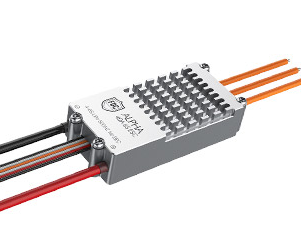
Two ESCs with the same current rating can behave completely differently on the same motor. One runs smooth and cool. The other buzzes at low throttle and gets hot. The difference is the control strategy, and the two names you need are FOC and standard, or trapezoidal, control.
Quick answer: FOC and standard, or trapezoidal, control drive the motor differently, which is why two ESCs with the same current rating can behave completely differently on one motor. FOC buys smooth low-rpm torque, lower heat and a few percent efficiency at part throttle, and it pays off on large, low-KV motors swinging 30-inch props or more, where our V200A 14S FOC is the usual answer. It does not add thrust: a 60A FOC ESC is still a 60A ESC. An FPV quad on 5-inch props never operates at low rpm, so a standard ESC is cheaper and works fine. See our propulsion overview and the ESC matching guide.
| Question | FOC | Standard / trapezoidal |
|---|---|---|
| Low-rpm smoothness | Smooth torque, low ripple | Buzzes at low throttle by design |
| Heat and efficiency | A few percent better at part throttle | Adequate on small fast props |
| Maximum thrust | Same as standard | Same as FOC |
| Where it pays | 30-inch props and up, low KV, 14S+ | FPV, small props, hobby builds |
| Setup | Some need motor parameters and a calibration pass | Plug and play |
Here’s what each one actually does, where the difference shows up in flight, and how to decide whether the premium is worth paying on your build.
What the two strategies do differently
A standard ESC switches the motor’s three phases in six fixed steps, timed to the back-EMF it can sense. Simple, cheap, and it’s been the default for years.
FOC, field-oriented control, does more work to get the same job done. It tracks the rotor position continuously and drives the phases with a sinusoidal current that stays at right angles to the magnetic field. The standard ESC pushes the rotor in lumps. FOC pulls it around smoothly.
That one difference is behind every practical benefit on the list below.
Torque ripple and low-rpm smoothness
The most visible difference shows up at low rpm. A standard ESC makes torque in six pulses per electrical revolution, and at low throttle you can hear and feel those pulses: a coarse buzz, vibration through the arm, a slightly ragged answer to a small throttle command.
FOC delivers torque evenly, and that matters most on large propellers and low-KV motors. A 40-inch propeller has real inertia, and getting it to start and stop smoothly is worth a lot on a heavy aircraft. It’s also why camera platforms with big props notice FOC first. Less vibration at the frame means cleaner footage.
Efficiency and heat
Sinusoidal drive keeps the current better aligned with the rotor’s magnetic field, so less of it turns into heat. On a long hover the difference is a few percent. That sounds small until you multiply it by a whole flight and by a fleet of aircraft.
The bigger effect is ESC temperature. FOC units usually run cooler at part throttle, which matters anywhere the ESC is buried. If you’ve ever had an ESC derate or shut down on a hot day in an enclosed bay, that’s the problem FOC addresses.
What FOC does not fix
FOC isn’t a power upgrade. It doesn’t raise a motor’s maximum thrust, and it won’t let you run a motor past its thermal limit. It also doesn’t change the need to size the ESC around peak current. A 60A FOC ESC is still a 60A ESC.
It adds cost, and on some units a little setup. Some FOC ESCs need the motor parameters and a calibration pass before the first flight. Call it ten minutes of work, but it’s real work, and you want to know about it before you order.
When a standard ESC is the right answer
Small, fast propellers on light airframes. An FPV quad racing on 5-inch props never operates at low rpm, so it has no use for smooth low-rpm torque. And the ESC is the part most likely to die in a crash, so the cheaper one is the sensible one to lose.
High-volume builds and weight-critical builds tell the same story. A standard ESC is lighter, simpler and cheaper, and there’s no efficiency penalty worth chasing at that size. Our standard range sits under FLAME series UAV ESCs, and it covers most of what a mid-size multirotor needs.
When to pay for FOC
Large propellers, low KV. The bigger the prop and the slower the motor, the more smoothness matters. Anything swinging 30-inch props or larger on a low-KV motor is FOC territory.
Heavy lift and industrial. When an ESC shutdown costs you an aircraft, the lower running temperature pays for itself. The V200A 14S FOC ESC is our standard answer at that weight, and the wider family sits under V Series FOC VTOL ESCs and ALPHA Series FOC UAV ESCs.
Aerial photography and inspection. Vibration is the product here, so smoother torque shows up straight in the images.
High cell counts. At 14S and above, current spikes are large and thermal margin is thin, so the cooler control strategy gets more room to prove itself.
Sizing is still the first question
Whatever control strategy you pick, the rating is what keeps the aircraft in the air. Take hover current from the motor’s thrust table, multiply by 1.5 to 2 for manoeuvres, round up to the next standard size. Then check the cell-count range. That one is a hard ceiling you can’t ignore.
If the numbers say 200A at 14S, that’s the requirement, and FOC is a refinement on top of it. If they say 60A at 8S on a light airframe, a standard ESC is the correct answer and the saving buys propellers. The full matching method is in matching an ESC to a motor and propeller, and the upstream logic in the propulsion guide.
Frequently asked questions
Is FOC always more efficient?
Usually a few percent at part throttle, and more on large low-KV motors. Full throttle on a small motor narrows that gap.
Does FOC give more thrust?
No. It hands you the same thrust, just smoother and with less heat. Maximum thrust comes from the motor, the propeller and the voltage, as the ESC matching guide explains.
Do FOC ESCs need special firmware?
Some do. They want the motor parameters and a calibration pass. Others are plug-and-play with fixed settings, so check before you order if the build has to fly soon.
Can I mix FOC and standard ESCs on one aircraft?
Technically yes, and we have seen it done. It is still a bad idea: different response on different arms shows up as uneven control.
Why does my standard ESC buzz at low throttle?
That is six-step commutation doing exactly what it is supposed to. It is normal for the technology, and it is one reason FOC exists, as our propulsion overview describes.
Tell us the motor, the propeller and the pack, and we will recommend the ESC class and the margin. The range is on our motor and propulsion page, with sizing detail in the ESC matching guide.


Pingback: UAV Propulsion Guide: Matching Motor, ESC and Propeller