
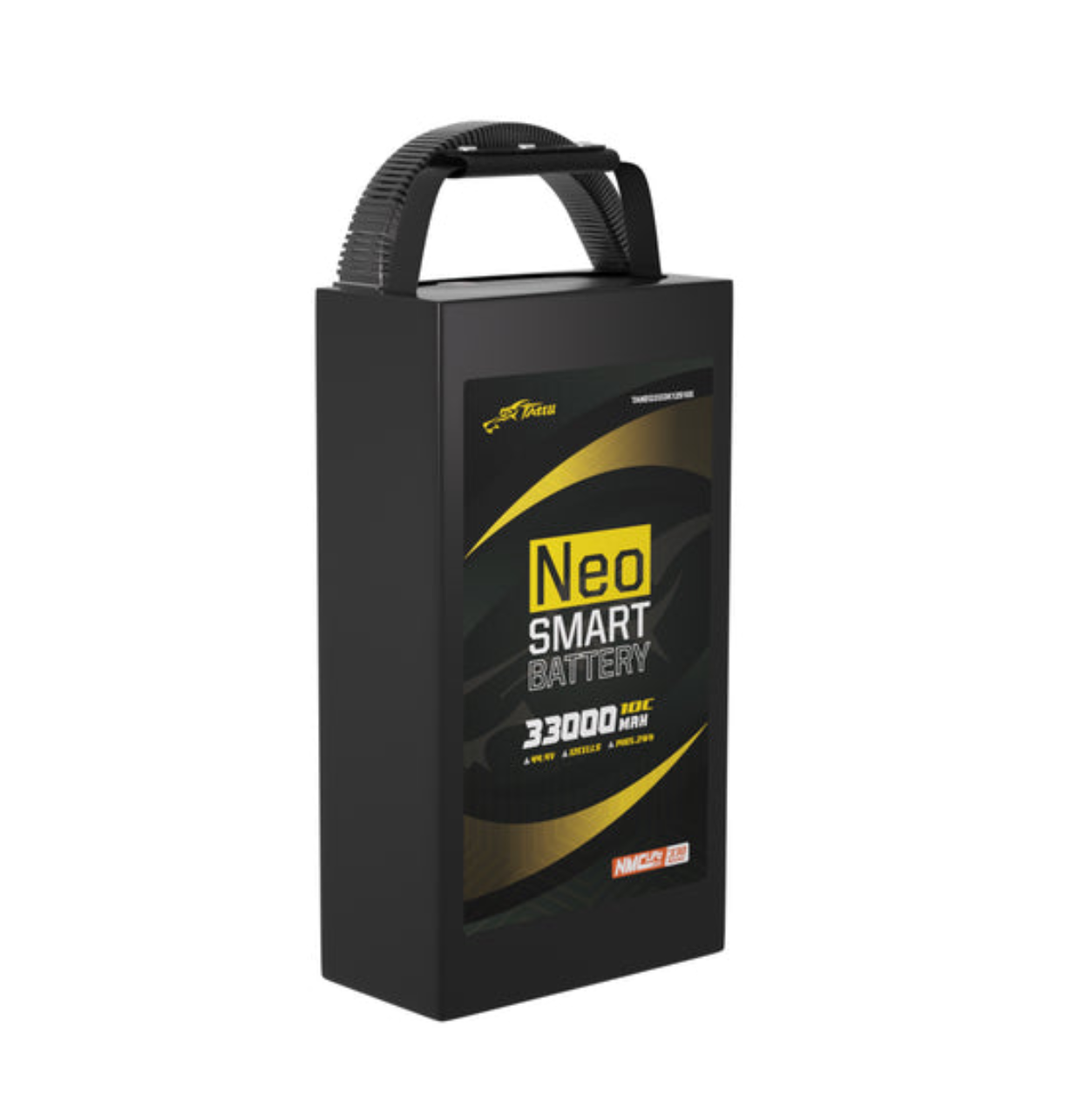
Sizing a battery comes down to two numbers: how much current your aircraft draws to stay in the air, and how long you need it to stay there. Get those two right and the pack nearly sizes itself.
Quick answer: Size the pack from hover current, not peak. A 10kg multirotor hovers around 45-55A, a 25kg agricultural machine sits around 110-130A, and a large 50kg rig crosses 200A. Decide the flight time you actually need, back out capacity treating 80% of rated capacity as usable, choose the cell count your ESCs accept, then sanity-check the C-rating against hover current. A well-matched multirotor hovers between 45% and 55% throttle, so if you are hovering near full throttle the pack is not the only problem. Background is in our UAV battery guide, with the rating itself in the C-rating guide.
| Airframe | Typical hover current | Usable capacity rule | What it drives |
|---|---|---|---|
| 10 kg multirotor | 45-55 A | 80% of rated capacity | Capacity in Ah sets flight time |
| 25 kg agricultural | 110-130 A | 80% | Pack must carry a 25C-class rating |
| 50 kg heavy lift | Over 200 A | 80% | Cell count first, current follows |
| Any build | Hover, not peak | 80% | C-rating checked against hover current |
Here’s the sequence we walk customers through, with the arithmetic laid out at every step so you can drop in your own airframe numbers.
Step 1: work out the hover current, not the peak
Peak current gets all the attention and almost none of the flight time. A multirotor spends the vast majority of a mission hovering or cruising, pulling a steady current well below its peak. That steady figure is what drains the pack.
Got a current sensor? Read the hover current straight off a real flight. Don’t have one? Estimate it from the motor’s thrust table at the throttle setting you hover at, then multiply by the number of motors. Handy check: a well-matched multirotor hovers somewhere between 45% and 55% throttle.
On the machines we see most often, hover current lands in familiar bands. A 10kg multirotor hovers around 45 to 55A. A 25kg agricultural machine sits around 110 to 130A. A large 50kg rig crosses 200A. Write your number down before you go any further.
Step 2: decide the flight time you actually need
Forget the flight time you’d like. Size for the time the mission requires. A line-inspection flight might need twelve minutes between landings; a mapping sortie might need thirty-five. Naming the real requirement early stops you buying capacity you’ll only spend carrying.
Step 3: back out the capacity
Flip the flight-time formula around and capacity falls straight out. Only about 80% of a LiPo pack is usable if you want the pack to survive.
Capacity (Ah) = hover current (A) × flight time (min) ÷ 60 ÷ 0.8
For a 25kg spray drone needing 9 minutes at 120A: 120 × 9 ÷ 60 = 18Ah of consumption, and 18 ÷ 0.8 = 22.5Ah. That’s where the 22000mAh packs come from. It’s the arithmetic of a real mission, not a marketing round number. The Tattu AGRI 22000mAh 12S is sized exactly for this band.
Then check the weight you just added. A 22000mAh 12S pack is around 5kg. If the aircraft was already near its thrust limit, you haven’t solved the problem, you’ve only moved it. Sometimes the honest answer is a lighter pack and a shorter flight.
Step 4: choose the cell count
Cell count is set by the power system more than by the battery. The ESC’s rated cell range and the motor’s KV decide it. Broadly, small airframes run 4S to 6S, mid-size industrial machines run 12S, and heavy or long-endurance aircraft move to 14S and 18S. Higher voltage means lower current for the same power, which is easier on wiring, connectors and heat.
Once you pick a cell count, re-read the motor’s thrust table at that voltage. Thrust and current both shift with voltage, and a hover current measured at 6S doesn’t transfer to a 12S build.
Step 5: the C-rating sanity check
Divide the pack’s continuous rating by your hover current. If the answer is under two, the pack is working harder than it should at cruise, and it’ll run warm and age quickly. A 25C 22000mAh pack delivers about 550A, so a 120A hover leaves a comfortable multiple of more than four. Where builds get marginal is small capacity with big current, which is exactly the FPV case, and there the answer is a high-C race pack rather than a bigger one.
Worked examples by payload class
Around 5kg, camera or mapping
Hover current roughly 20 to 25A. For a 25-minute flight: 22 × 25 ÷ 60 ÷ 0.8 ≈ 11.5Ah. A 6S 11000 to 16000mAh pack fits well, and the G-Tech 6S 22000mAh gives useful margin if you’d rather not fly to the edge.
Around 10kg, inspection
Hover current roughly 50A. For 20 minutes: 50 × 20 ÷ 60 ÷ 0.8 ≈ 21Ah. A 12S 16000 to 22000mAh pack such as the AGRI 16000mAh 12S or the Plus 1.0 Compact 16000mAh covers it.
25kg and up, agricultural and heavy lift
Hover current 120A and above. For 9 minutes: 22.5Ah, so the AGRI 22000mAh 12S. When the mission needs more than that, the answer is usually a lighter, denser chemistry rather than a heavier pack, and the NEO 30000mAh semi-solid 12S and the Tattu 4.0 14S are built for that shift.
For spray drones there’s a second constraint on top of all this: the spray itself. Tank size, pump draw and route length change the sum, which is why we keep a separate walkthrough in the agricultural drone battery selection guide.
Frequently asked questions
Should I size for hover current or peak current?
Size the capacity for hover current, because that is what drains the pack. Check the C-rating against hover current too and let the ESC deal with the peaks, as the C-rating guide sets out.
How much capacity should I leave unused?
Land at about 20% remaining, so treat 80% of rated capacity as your usable figure. Running to 3.5V per cell shortens pack life quickly.
Will a second identical pack in parallel double my flight time?
It roughly doubles capacity, but the extra weight pushes hover current up, so you get a little less than double. On light airframes the gap is small; on loaded ones it is not.
Can I just buy the biggest pack that fits?
Usually not. Past a certain point the extra capacity goes into lifting itself and the gains flatten or turn negative, which is why we size packs in the UAV battery guide before selling a bigger one.
How do I know my hover current without flying?
Work it out from the motor thrust table at your hover throttle, times your motor count, then check it with a current sensor on the first flight.
Send us the all-up weight, the cell count your ESCs accept and the flight time you need, and we will work the numbers with you and point at the pack that fits. The range is on our UAV battery page, with background in the UAV battery guide.

Pingback: UAV Battery Guide: Voltage, Capacity and Pack Sizing