
The chemistry question sounds academic right up until you’re picking a pack for an aircraft that has to fly for ninety minutes. Then it turns into the one decision that sets your payload, your range, and how often you swap the pack out.
Quick answer: LiPo is the power chemistry and Li-Ion is the energy chemistry. LiPo sits around 180-200Wh/kg with 25C on a large AGRI 22000mAh 12S pack and 100C or more on race cells, but a hard-worked pack may only reach 150-300 cycles. Li-Ion cylindrical and semi-solid packs push toward 250-300Wh/kg at 3C-5C continuous and can run 500-800 cycles, and they tolerate months at partial charge. Choose LiPo when you need current and can swap packs; choose Li-Ion when flight time, fleet cycle cost and idle storage dominate and your hover current stays inside the rating. The background is in our UAV battery guide, with the middle ground covered in the semi-solid comparison.
| Chemistry | Energy density | Continuous rating | Cycles to 80% | Best for |
|---|---|---|---|---|
| LiPo | 180-200 Wh/kg | 100C+ race cells, 25C on AGRI 22000 12S | 150-300 | FPV, sprayers, short high-current flights |
| Li-Ion 18650/21700 | 250-300 Wh/kg | 3C-5C | 500-800 | Long endurance, fleets, months idle |
| Semi-solid / high voltage | About 300 Wh/kg | Read the pack datasheet | Not stated | Endurance plus high-voltage platforms |
| LiPo HV 6S | 22.8V nominal | Pack specific | 150-300 typical | Builds already rated for HV |
Here’s how the two families actually differ on a working UAV, and where each one stops being the right answer.
They are closer than the names suggest
Both are lithium cells. The difference lives in the cathode and the electrolyte. Li-Ion cells (the cylindrical 18650 and 21700 style, and the pouch cells derived from them) are built for energy. LiPo cells are built for current. That one design choice cascades into everything else: weight, discharge ability, safety margin and price.
The phrase we hear most often is “LiPo vs Li-Ion,” but on professional UAVs there’s a third option worth knowing about now. Semi-solid state cells sit between the two, and we’ll come back to them.
Energy density: Li-Ion’s home ground
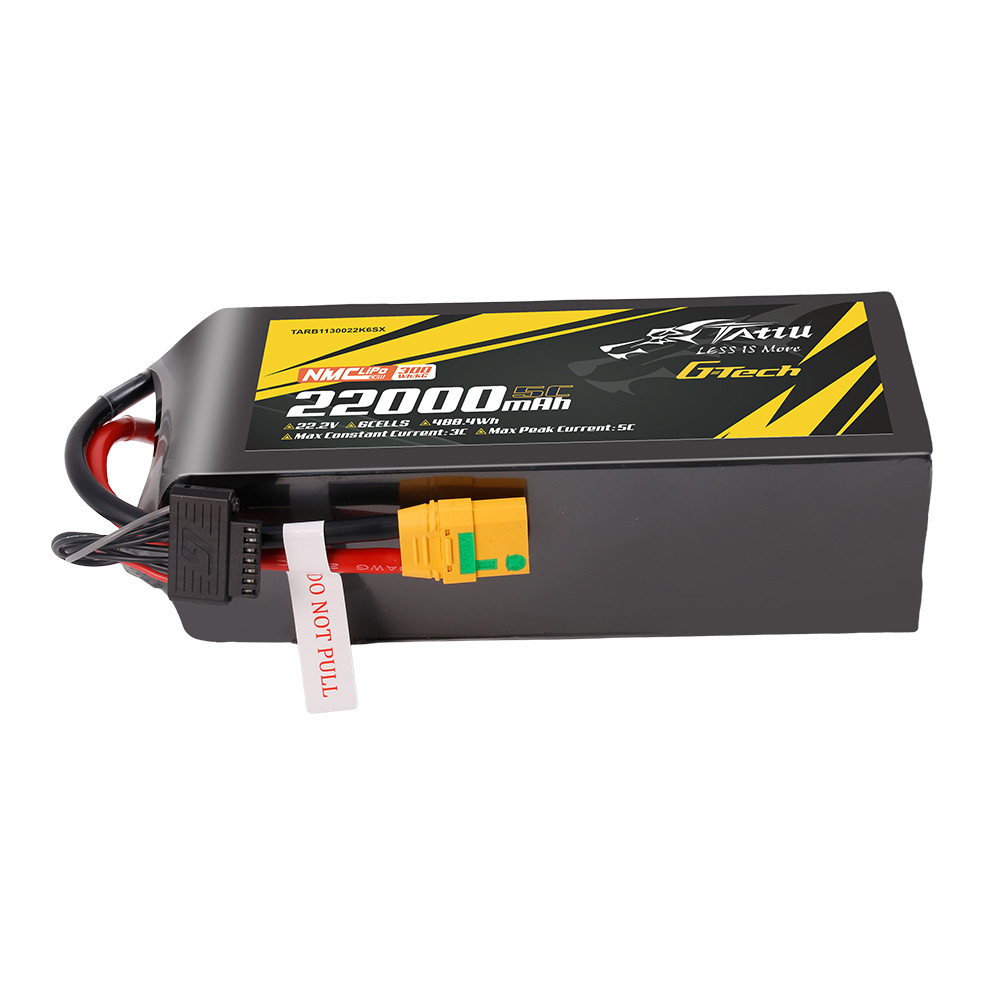
Li-Ion wins on watt-hours per kilogram, and it isn’t close. Conventional LiPo sits around 180 to 200Wh/kg. Li-Ion cylindrical cells and semi-solid state packs push toward 250 to 300Wh/kg. The Semi-solid State 300Wh/kg 22000mAh 6S is named for exactly that figure.
On a long-endurance fixed-wing or a survey multirotor, that gap is the whole game. Every kilogram saved in the pack is a kilogram available for payload, or another few minutes in the air. This is why battery-electric aircraft with real endurance, and the road vehicles the cells were originally developed for, run Li-Ion.
C-rating: LiPo’s home ground
Discharge current is where Li-Ion gives ground back. A typical Li-Ion cell is comfortable at 3C to 5C continuous. A LiPo race cell is rated at 100C or more, and even a large UAV LiPo like the AGRI 22000mAh 12S carries a 25C rating.
For a spray drone hovering at 120A, a Li-Ion pack of the same capacity would be running close to its ceiling before the pump even switched on. We’ve had customers try it on a full tank anyway, and that pack doesn’t come back happy. For an FPV quad pulling 90A in a punch-out, Li-Ion is simply the wrong tool. High current is LiPo’s reason to exist.
Cycle life and calendar life
Li-Ion lasts longer as well. A well-treated Li-Ion pack can run 500 to 800 cycles before it drops to 80% capacity; a hard-worked LiPo might see 150 to 300. That gap matters most on fleets, where packs are amortised over hundreds of flights rather than replaced by enthusiasts every season.
Calendar life gets talked about less, and it’s just as real. Li-Ion cells are happier sitting at partial charge for months. LiPo packs that spend the winter fully charged will lose capacity whether you fly them or not. Storage habits are covered in drone battery charging and storage.
Temperature and cold
Both chemistries lose capacity in the cold, and both need warming before a winter flight. Li-Ion tends to hold voltage better at low temperature, but its internal resistance climbs, which limits current further. LiPo warms up faster under load, which is useful on a short cold-weather mission and a liability if you push a cold pack hard from the first second.
The practical rule for winter work: keep packs at room temperature until launch, insulate the battery bay, and accept a shorter flight rather than a hotter pack.
The middle ground: semi-solid and high voltage
You no longer have to pick a corner of the trade-off. Semi-solid state packs deliver roughly 300Wh/kg while still offering 10C discharge, enough for a hovering multirotor, not quite enough for a racing quad. High-voltage LiPo is a smaller step in the same direction: same chemistry, a little more energy per cell, at 22.8V on 6S rather than 22.2V.
The NEO 30000mAh semi-solid 12S and the NEO Compact G330 36000mAh 14S are what that middle ground looks like as a product. If you’re choosing for a long-endurance UAV today, this is usually where the decision lands.
So which one for which mission
Agricultural spraying. High current, short flights, rough handling. LiPo, and plenty of capacity for the hover load. Start with the AGRI 12S line.
Survey, mapping and long-endurance inspection. Energy density first. Semi-solid or Li-Ion, sized by watt-hours rather than mAh. The Tattu 4.0 30000mAh 14S covers the large end.
FPV racing and freestyle. LiPo only, and the higher the C-rating the better. The R-Line 1300mAh 6S 120C is the kind of cell that belongs here.
Fleet operators. Whatever you choose, standardise it. A fleet running one chemistry with one charger regime ages far more predictably than a fleet where every aircraft has its own favourite pack.
Frequently asked questions
Can I swap a Li-Ion pack into a drone built for LiPo?
Physically, often yes. Electrically, only if the ESC and motor draw stay inside the Li-Ion pack’s C-rating, which for a spraying drone they usually do not, as our UAV battery guide explains.
Is Li-Ion safer than LiPo?
The cells take more abuse, but a lithium pack of either chemistry can fail if it is punctured, over-charged or shorted. Safety comes down to charging and handling discipline, covered in our battery safety guide.
Why is a LiPo pack rated 25C when I only pull 5C?
Because the rating is a ceiling for the whole pack and says nothing about how you fly. It also leaves margin for a hot day and for voltage sag near the end of a flight.
Do semi-solid cells need a special charger?
No. Cell count and voltage decide the charger. A 6S semi-solid pack charges like any other 6S pack, as long as your charger’s cell range covers it.
Which chemistry ages best if a drone sits idle for months?
Li-Ion, stored at partial charge. A LiPo kept fully charged through a long idle stretch is the fastest way to lose capacity, which is why we cover extending pack lifespan separately.
Still weighing it up? Tell us the mission, the hover current and the flight time you need, and we will tell you which chemistry and which pack size fits. The wider context is in our UAV battery guide, and the high-voltage options are in the HV pack guide.


Pingback: UAV Battery Guide: Voltage, Capacity and Pack Sizing