KV is the question we get most often about a motor datasheet, and it’s the one that gets misunderstood the most. People read it as a power rating, a quality score and a speed setting all at once. Those aren’t what it is.
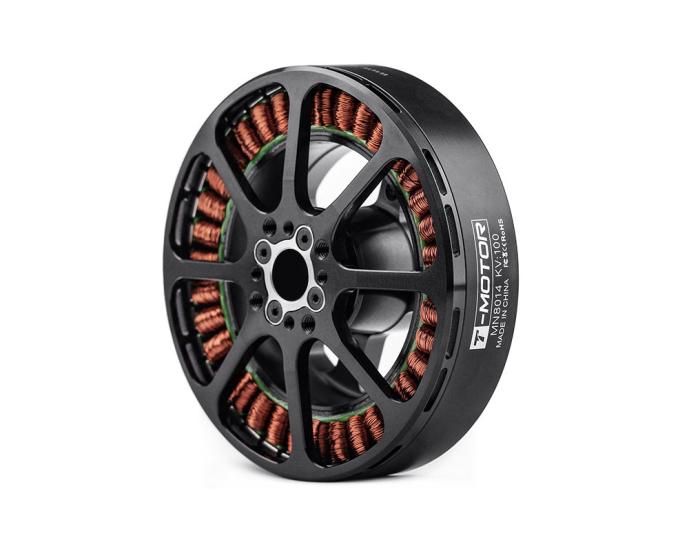
Quick answer: KV is a motor’s no-load speed per volt, nothing more. Multiply it by pack voltage and an MN8014 KV100 on 12S at 44.4V turns at roughly 4,440rpm, and half that on 6S. High KV suits small propellers at 4S-6S; 120KV to 320KV motors swing 15- to 22-inch props; heavy-lift multirotors usually run 29KV to 60KV on 14S-24S with 40-inch or larger blades. A 40KV motor such as the MN1330 KV40 is big and heavy because low KV needs more winding turns and a bigger stator, and that mass is what buys torque. Read the thrust table at your voltage before you commit. See our motor selection guide and the propulsion overview.
| KV band | Propeller it suits | Voltage it suits | Typical use |
|---|---|---|---|
| 650KV | Small, fast props | 4S-6S | Small quads and cinewhoops |
| 120-320KV | 15-22 inch | 6S-12S | Mid-size multirotor |
| 100-120KV | Large blades | 12S | Agricultural and heavy lift |
| 40-60KV | 40 inch and up | 14S-24S | Heavy-lift multirotor |
| 29-60KV | 40 inch and up | 14S-24S | Cargo and manned-class lift |
So here’s what KV actually measures, how it moves with voltage and propeller size, and how to pick it for the airframe you’re really building.
KV is rpm per volt
KV is the motor’s no-load speed constant. Multiply it by your pack voltage and you get the rpm the motor would spin with nothing bolted to it: a MN8014 KV100 on a 12S pack (44.4V nominal) turns at roughly 4,440rpm. Put that same motor on 6S and it turns at half that.
Voltage and KV trade against each other, and that’s the first thing to hold on to. Halve KV, double the cell count, same rpm. The second is that KV says nothing about torque or power on its own. It only describes the speed the motor wants to run at.
Why low KV motors are physically bigger
To make torque, a motor needs more turns of wire working against the magnets, or a bigger stator radius. Wind a motor for low KV and you’re putting in more turns of thinner wire, which needs more room. That’s why a 40KV motor like the MN1330 KV40 is a big, heavy, high-torque unit, while a 650KV motor of the same class is small and fast.
The trade never changes. You either get a big, slow, high-torque motor swinging a large propeller efficiently, or a small, fast motor spinning a small propeller hard. Neither one is better in the abstract. One of them matches your aircraft, and that’s the only test that counts.
KV, voltage and propeller size move together
A propeller is a load, and the current a motor pulls climbs steeply as rpm goes up. Hang a large propeller on a high-KV motor at high voltage and you push the motor past the point where it can turn that load. The excess doesn’t become thrust, it becomes heat. So the pairing has to be picked together:
Small, fast multirotor. High KV, small props, 4S to 6S. A 120KV to 320KV motor with a 15- to 22-inch prop lives at the other end of the same scale.
Mid-size industrial multirotor. 80KV to 120KV on 12S with 26- to 30-inch props. The MN8017 KV120 is the one we point at for this class.
Heavy lift and manned. 29KV to 60KV on 14S to 24S with 40-inch-plus props. The U15XXL 29KV and the VL1380 both live here.
Fixed-wing and VTOL pusher. Higher KV, because the prop is smaller and pitched for cruise speed. The AT4120 comes in KV250, KV500 and KV560 for exactly that reason.
The thrust table overrides every rule of thumb
Everything above is just a starting point. The document that actually decides it is the manufacturer’s thrust table. It lists thrust and current at a given throttle, for a given propeller and voltage. If the table says a motor delivers 9kg at 75% throttle on 12S with a 30-inch prop, that’s the number you design around. Not the KV.
Read three rows: the hover row (roughly half of maximum thrust), the maximum-thrust row, and the current column next to both. The hover row is what sizes your ESC. The maximum row tells you what the aircraft can do when a gust hits.
The mistakes we correct most often
Choosing KV before propeller. Settle the prop diameter your frame can swing first, then pick the KV to suit it. Do it the other way round and you end up with motors that are too fast for their props. This is the one we see come back.
Assuming more cells means more power. More voltage on the same KV raises rpm and current together. We’ve had customers who pushed a motor from 6S to 12S on the same ESC and cooked it. If yours was sized for the old cell count, it’s undersized now.
Comparing KV across motor sizes. A 100KV 8014-class motor and a 100KV 1330-class motor are completely different machines. KV only means anything within one size class.
Ignoring the efficient band. Hovering a motor at 90% throttle leaves you nothing in reserve for a gust, and it keeps the ESC hot. Aim to hover near half of the published maximum thrust.
Picking KV in one pass
Fix the frame and the largest propeller it can swing. Work out thrust per motor from all-up weight, and you’ll want a factor of two in there. Find the thrust table that clears that figure on a mid-throttle row. Take the KV and voltage that match your pack. Check the hover current against the ESC rating. Then confirm the whole chain with the propulsion guide and the motor-first workflow in how to choose a brushless motor.
Frequently asked questions
Is higher KV better?
No. KV just describes speed per volt. Higher KV suits smaller propellers and lower voltage; lower KV suits larger propellers and higher voltage, as the motor selection guide lays out.
Can I use a 6S pack on a 12S motor?
Yes, as long as the KV and propeller still give you the thrust you need at that lower voltage. Expect about half the rpm and read the thrust table at 6S.
Does KV change with the propeller fitted?
The KV constant does not change. The actual rpm does, and it drops under load. The gap between no-load and loaded rpm is where the motor’s efficiency lives.
What KV for a heavy-lift multirotor?
Usually 29KV to 60KV on 14S to 24S with 40-inch or larger propellers, which is the range covered in our heavy-lift motor guide. Size it from the thrust table, not the KV number.
Why is a low-KV motor heavier?
Low KV needs more winding turns and a bigger stator. Both add copper, iron and mass, and that mass is what buys you the torque.
Tell us the frame size, the pack you plan to run and the payload, and we will point you at the KV and propeller combination that clears it. Motors and their thrust figures are listed on our motor and propulsion page, with the sizing method in the propulsion overview.