
A VTOL and a multirotor both climb on vertical lift, so it’s tempting to think the same motor will do both jobs. It won’t. A VTOL lift system runs for a few minutes a flight, hides inside a wing or a boom, and has to fold flat. A multirotor lift system runs the whole time, sits out in open air, and never folds. Those three differences are what pick the hardware.
Quick answer: A VTOL lift system runs for a few minutes a flight, hides inside a wing or boom and has to fold flat; a multirotor lift system runs the whole time, sits in open air and never folds. Those three differences pick the hardware. VTOL lift motors lean toward higher KV for the same weight, the VL8022 KV170 against a mid-size multirotor motor at 100-120KV, and they run hotter because airflow past the windings is restricted and the duty cycle is on-off. VTOL systems are sized tighter, so an ESC at 1.5 times hover current often is not enough. On anything that cruises on a wing, the propeller has to fold. See our motor selection guide and the propulsion overview.
| Property | VTOL lift motor | Multirotor motor |
|---|---|---|
| Duty cycle | Minutes per flight | Whole flight |
| Cooling | Restricted airflow inside a wing or boom | Open air with prop wash |
| Propeller | Folding, 30-45 inch on large frames | Fixed, or folding on some industrial frames |
| KV for the same weight | Higher, e.g. VL8022 KV170 | Lower, e.g. 100-120KV mid-size |
| ESC margin | Often more than 1.5x hover current | About 1.5-2x hover current |
| Voltage | 14S mid-size, 24S on cargo and manned | 6S-12S common, 24S on heavy lift |
So here’s how the two stack up where it counts, and how to figure out which side of the line you’re on.
Duty cycle is the first difference
A multirotor hovers the whole flight. Its motors sit at a steady load, and they have to be efficient at that one point. A VTOL lift motor is the opposite. It grunts at high load for take-off and landing, then shuts off while the aircraft cruises on the wing. Short duty cycle, yes, but the load inside that window is higher, because VTOL lift systems usually get sized tighter than a multirotor’s.
What that means in practice: you can push a VTOL lift motor closer to its max thrust, and it doesn’t need the last few percent of hover efficiency a survey multirotor lives on. What it does need is to survive repeated thermal cycling. That’s a harder ask than a steady state.
Cooling is harder than it looks
On a multirotor, the propeller shoves air straight over the motor, and the ESC usually sits in that airstream too. On a VTOL it’s a different story. The lift motors are often buried in a fairing with barely any airflow, and they spend cruise sitting still, cooking in whatever heat the electronics bay has built up.
This is the one we see come back most: a VTOL lift motor dying earlier than the same motor on a multirotor. Two habits help. Leave the motor exposed instead of faired where the aero penalty is tolerable. And let the system idle the lift motors briefly through transition, so heat has somewhere to go instead of soaking into the windings.
Disc loading and propeller size
Lift comes down to how much air a prop moves and how fast it moves it. VTOL frames usually aren’t given as much room between arms and booms, and the lift props sit closer to the wing. That pushes designers toward a slightly smaller diameter spinning faster. Smaller and faster raises disc loading, and disc loading costs you efficiency. So VTOL lift motors lean toward higher KV than a multirotor motor carrying the same weight: the VL8022 KV170 against a mid-size multirotor motor at 100KV to 120KV.
Where a VTOL does have room, it uses it. The heavy end of the range swings 30- to 45-inch propellers, and the VZ30x12 and larger cover cargo and logistics airframes.
Folding and mounting hardware
A multirotor prop is bolted on and it stays on. A VTOL lift prop has to fold back, so the aircraft can fly cleanly on the wing. That means a folding hub, and very often a quick-lock motor mount so you can pull the whole assembly for transport or service.
That hardware is part of the propulsion decision. It isn’t an accessory you bolt on later. Quick-lock changes the way prop balance feels, and a folding hub adds flex that a rigid bolt-on mount doesn’t have. The VL8020 is built around a 360-degree adjustable locking mount for exactly this reason, and folding propellers live under folding propellers.
Cell count and voltage
VTOL power systems tend to run higher voltage than an equivalent multirotor, because the lift phase is short and the current spikes are big. 14S is common at the mid-size end, and 24S turns up on cargo and manned aircraft. Same rule as everywhere else: match the pack cell count to the ESC’s rated range, and read the thrust table at the voltage you’ll actually fly.
Through transition the current spikes hard, because the lift motors are fighting the wing. That’s the moment your ESC margin gets tested, and it’s why a VTOL ESC sized at 1.5 times hover current often isn’t enough. Build in closer to two.
Which motor for which job
Multirotor, industrial and survey. Hover efficiency runs the show here. MN Antigravity motors from the MN8014 KV100 upward, paired with large diameter, lower-pitch propellers.
VTOL lift, small to mid. Higher KV, folding props, quick-lock mounts, tighter thermal margin. The VL8018 KV180 is sized for larger VTOL airframes that need high per-motor thrust.
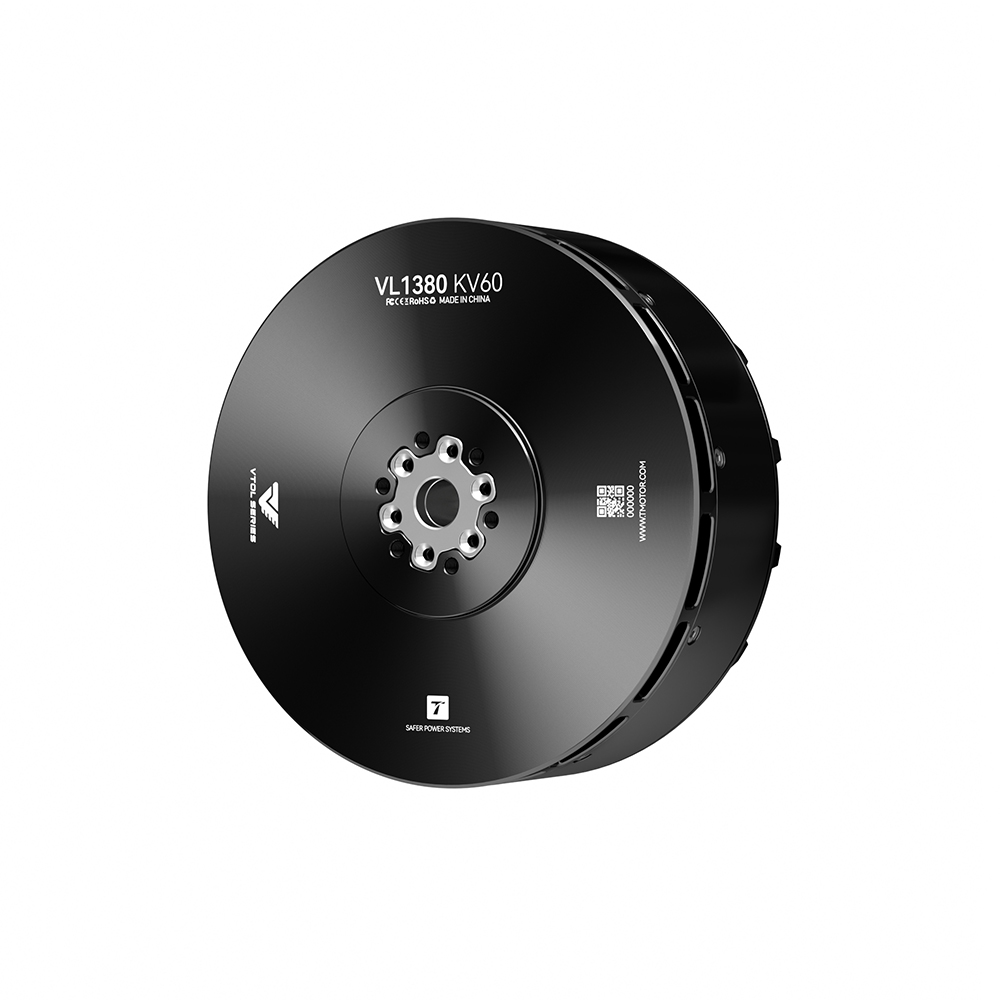
VTOL lift, cargo and manned. Low KV, high voltage, carbon propellers. The VL1380 sits at the top end of the range; see heavy lift drone motors.
VTOL pusher. A third motor, sized for cruise instead of lift, and usually pitched differently. The AT4120 comes in three KVs for exactly this job.
Deciding in practice
Ask yourself three things: how long the lift motors run, where the air around them goes, and whether the props have to fold. Continuous lift? Choose for hover efficiency and open-air cooling. Short and enclosed lift? Choose for peak thrust, thermal cycling and mounting hardware, and accept a slightly higher KV. The rest of the chain (KV, thrust tables and ESC sizing) follows the same logic either way, as set out in the propulsion guide.
Frequently asked questions
Can I use multirotor motors on a VTOL?
Mechanically yes, and it is common on small airframes. But if the lift motor has to fold, check the mount and the hub before you commit, which is the point of our VTOL motor comparison.
Do VTOL lift motors need to be more powerful?
They are usually sized tighter against all-up weight, so they run closer to max thrust through take-off and landing.
Why do VTOL motors run hotter?
Restricted airflow, plus an on-off duty cycle. During cruise the heat soaks into the windings instead of getting carried off by prop wash.
Should VTOL lift props fold?
Yes, for anything that cruises on a wing. A fixed prop adds drag and can be damaged in a belly landing.
Does higher KV mean a less efficient VTOL?
Not on its own. Higher KV with a smaller prop trades efficiency for compactness, and on a short lift phase that is often the right trade, as our propulsion overview explains.
Tell us the layout, the lift time and whether the propellers need to fold, and we will point you at the right VTOL or multirotor motor. The range sits on our motor and propulsion page, with matched sets covered in the propulsion kit guide.


Pingback: UAV Propulsion Guide: Matching Motor, ESC and Propeller