Spray drones live a harder life than any other UAV we sell parts for. They carry the most weight, they fly low over dust and chemicals, and they work the same field all season. Get the motor, propeller and battery matched well and one machine covers a lot of ground. Get them wrong and you’re rebuilding between jobs.
Quick answer: Start with the tank, not the motor. A 10L tank is 10kg of liquid, a 16L tank is 16kg, and with frame, arms, pump, nozzles, flow meter and pack a 16L spray drone is often 45kg or more at take-off with a full tank. That puts you on 28-30 inch carbon blades and the P60 and P80 family at 12S or 14S, with sealed bearings because spray drift eats bearings for breakfast. Settle the cell count before the capacity, and size the machine by tank loads rather than minutes in the air. See our application guide and the battery sizing guide.
| Tank | Liquid mass | Typical all-up | Prop and motor class |
|---|---|---|---|
| 10 L | 10 kg | 40 kg or more | 28-30 inch, P60/P80 at 12S-14S |
| 16 L | 16 kg | 45 kg or more | 28-30 inch carbon, P80 class |
| Cell count | 12S or 14S | Settle it before capacity | Combo packs such as P80-X |
| Wear items | Bearings and connectors | Dust and chemical | Sealed motors and clean plugs |
Here’s how we think about an agricultural set-up, in the order the decisions actually get made.
Start with the tank, not the motor
Tank size is the whole design brief. A 10L tank means 10kg of liquid, a 16L tank means 16kg, and spray liquid moves. It sloshes to one side in a turn and back again in the next one, so the aircraft has to carry a payload that shifts under it. That’s different from a camera that sits still.
Add the frame, the arms, the pump, the nozzles, the flow meter and the pack, and a 16L spray drone is often 45kg or more at take-off with a full tank. That number, the all-up weight with a full tank, is the one you size everything around. Not the empty weight.
Motor: low KV, sealed, built for the dust
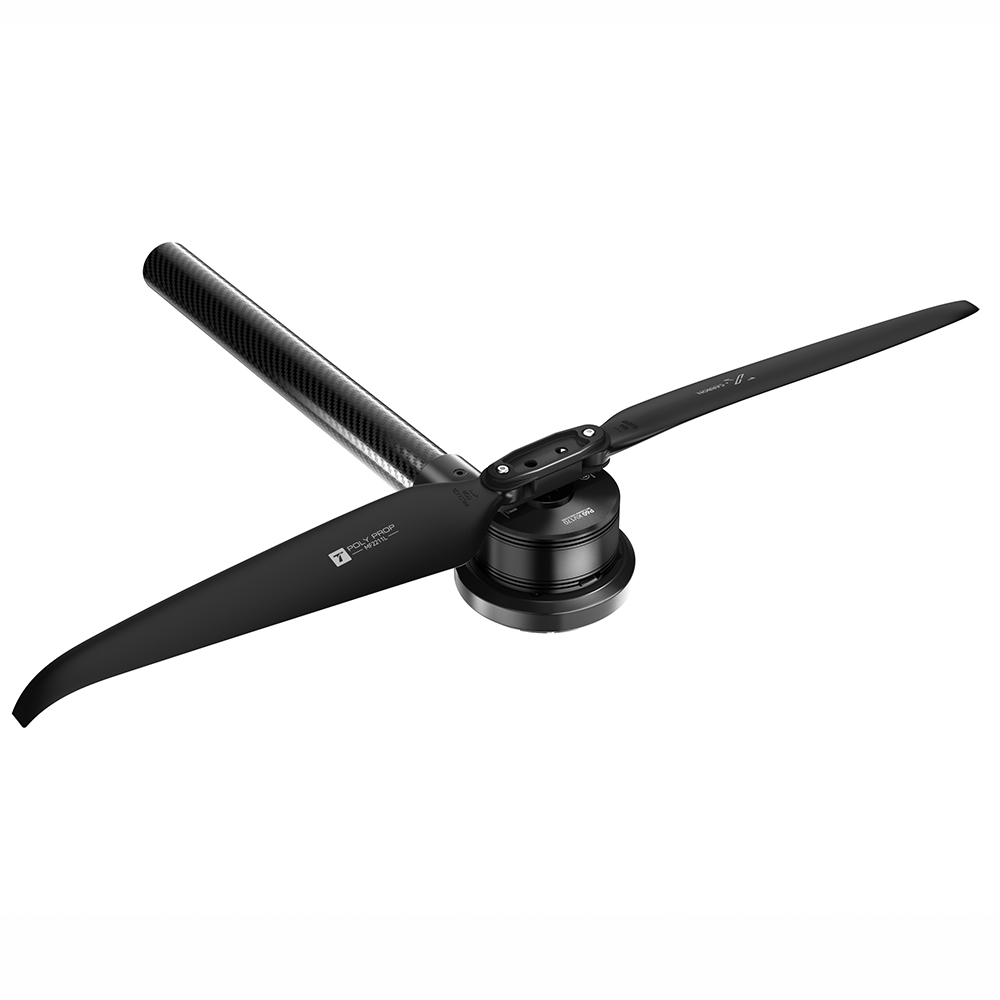
Spray drones want low KV motors that swing big props at high voltage. The P-type agricultural motors are made for this class: the P60 and P80 family run on 12S and 14S, swing 28 to 30 inch propellers, and are the motors we quote most for a 10 to 16L machine. The P80-X combo pack takes the matching out of your hands if you’d rather not chase thrust tables.
Two details matter more on a spray drone than on anything else. Sealed bearings, because airborne chemical and fine dust destroy unprotected ones fast. And a motor that holds its efficient point at a heavy hover, because a spray drone hovers and climbs-full and hovers again all day.
Propeller: big and stiff, and folding helps
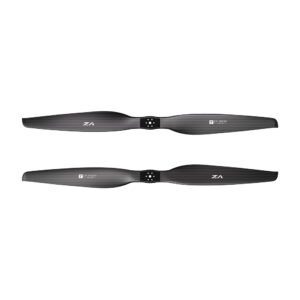
A large, stiff propeller is what turns motor torque into lift at these weights. On a 45kg machine you’re looking at 28 to 30 inch blades, and carbon fibre earns its place here for stiffness under load. A blade that flexes at a heavy hover loses efficiency and starts hammering the hub. We cover materials in the propulsion comparisons, and the range is under UAV carbon fibre propellers.
Folding props are worth it if the machine travels between fields. It’s a small weight penalty for a much easier transport job.
Battery: cell count first, then capacity
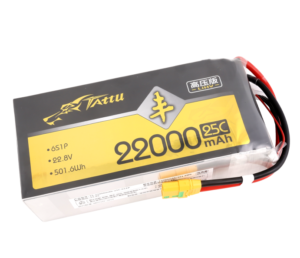
Cell count sets the voltage the whole system runs at, and once you’ve built around 12S or 14S you don’t change it casually. Capacity is what buys hectares per sortie. The honest way to size it is by tank loads, not minutes. How much juice does one full tank need? Multiply by the number of loads you want per charge. Our agricultural drone battery guide runs that calculation with real ROI numbers, and the general method is in the UAV battery guide.
Don’t forget C-rating. A spray drone draws big bursts on climb-out, and a pack that sags under load will pull the whole system down with it. Match the pack to the current, not just the capacity.
Charging, connectors and field conditions
Spray season is hard on batteries, and most of the failures we hear about aren’t the pack giving up mid-air. They’re the pack quietly losing capacity because it was stored hot, or a connector that corroded and started dropping voltage. Store packs cool and at the right voltage when the season ends. Keep the leads and plugs clean and dry. In a dusty field, a wipe-down at the end of the day is the cheapest maintenance you’ll ever do.
Charging matters too. Field charging between loads is normal on a spray drone, so plan for it: enough packs to rotate, and a charger that can put a pack back to full while the next one flies. If you’re running one pack and a slow charger, you’re watching the drone sit on the ground, which is the same as not owning a second pack.
The checks we run before a season
Four things, every time. Thrust margin: can the machine hover at no more than half its available thrust with a full tank? Current headroom: are the ESCs comfortably above hover current? Battery health: are the packs still holding voltage under load after last season? And connections: are the motor plugs and battery leads clean, because spray drift corrodes everything it touches.
Quick recipe for a 10L and a 16L machine
Around 10L
Lower end of the P-type range, 12S packs, 28 inch props, sealed bearings, and a pack sized for your field per charge. Start with the P-type motors and a matching pack.
Around 16L
P80 class motors, 14S if your system allows it, 30 inch carbon props, and a bigger pack. The A16L-24S modular system is the integrated route if you want the whole set matched. Full component options are in the agricultural set-up breakdown.
Frequently asked questions
Can I run a bigger tank on my existing frame?
Only if there is thrust margin left. Adding litres adds weight everywhere, and the ESCs usually run out of headroom before the motors do.
Why do my motors get hot during spraying?
Usually too much weight for the propeller and KV combination, so the motor sits above its efficient point. Re-check the thrust table at your real all-up weight.
How long should a spray drone fly per sortie?
Long enough to empty the tank with margin left. It is more useful to size by tank loads than by minutes, which is the approach in our application guide.
Is carbon fibre worth it for spray drone props?
Yes, at this weight. Stiffness holds efficiency at a heavy hover and copes better with the loads a spray drone puts through the hub.
What wears out first on a spray drone?
Bearings and connectors, because of the dust and chemical. Sealed motors and clean plugs are the two cheapest ways to extend the season.
Tell us tank size, all-up weight and how many loads you want per charge, and we will match the motor, propeller and pack around it. The range sits on our motor page and the UAV battery page.