
Everyone says “delivery drone” like it’s one machine. It isn’t. A drone that drops a 2kg parcel is a completely different animal from one that lifts 50kg, and lumping them together is how people end up buying the wrong thing. So let’s split delivery by payload class, because that’s how the hardware splits too.
Quick answer: Delivery splits by payload because the hardware splits there. Under about 5kg it is a standard multirotor with a release mechanism and a camera. Between 5kg and 30kg the aircraft gets bigger and thrust margin starts to bite: a 20kg payload needs bigger motors, larger props and a serious pack. Above 30kg hovering becomes expensive and a VTOL makes more sense, because cruise costs far less than hover. In every class, plan to hover at half your available thrust or better, estimate range from energy with a reserve, and use large stiff carbon props. See our heavy-lift motor guide and the VTOL motor comparison.
| Class | Payload | Airframe | What decides it |
|---|---|---|---|
| One | Up to about 5 kg | Standard multirotor with a release | Simplicity |
| Two | 5-30 kg | Larger multirotor | Thrust margin and pack energy |
| Three | 30 kg and up | VTOL | Cruise is far cheaper than hover |
| All classes | Any payload | Hover at 50% thrust or better | Reserve for gust and warm days |
Class one: light parcels, up to about 5kg
This is a standard multirotor with a release mechanism and a camera. Payload is small, so the aircraft is efficient and the range is decent even on a hovering platform. The interesting engineering here isn’t the lift, it’s the release and the safety case. You need a mechanism that only lets go when you intend it to, and a flight plan that keeps people out from under it. Nothing about the propulsion is exotic. Ordinary multi-rotor motors, ordinary props, a well sized pack.
Class two: mid payload, roughly 5kg to 30kg
Here the aircraft gets bigger and the trade-offs start to bite. A 20kg payload needs a lot of thrust, which means bigger motors, larger props and a serious pack. You pay for it in energy. Every kilo you lift costs current, and current costs capacity, and capacity costs weight, and that weight costs you more thrust again. This is where people discover that a bigger hexacopter starts fighting itself.
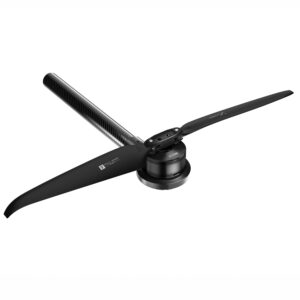
For this class, multi-rotor UAV motors with heavy-lift capability and large carbon props are the usual path. If the range is short and the payload is under about 30kg, a multirotor is still the simplest answer, and the reasoning on thrust margin is in heavy lift drone motors.
Class three: heavy payload, 30kg and up
Past 30kg, hovering becomes expensive and a VTOL starts to make sense. A VTOL lifts off vertically on its lift motors, then transitions to level flight on a pusher prop, where the wing carries the weight instead of the rotors. Cruise is far more efficient, so the range is much better for the same pack. The cost is complexity: two propulsion systems, a transition to manage, and lift motors that have to deliver a lot of thrust for a short time.
On the lift side, VTOL motors like the VL and V series cover the middle of this range, and at the very top the U15XXL 29KV combo is what you’re looking at for a very large machine. For the props, the heavy end runs on large carbon blades like the VZ45x18.
Thrust margin is not optional at these weights
Hover at half your available thrust or better. A 50kg aircraft wants at least 100kg of thrust available, split across its motors. If you plan to hover at 80 percent throttle, you have no margin for a gust, for a hot day, or for a pack that’s sagging. Delivery work is predictable in weight and unpredictable in weather, and margin is what covers the difference.
We go through the thrust-table method in the propulsion guide, and it’s the same arithmetic whether the payload is a parcel or a camera.
Battery and energy for range
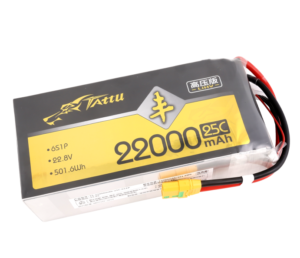
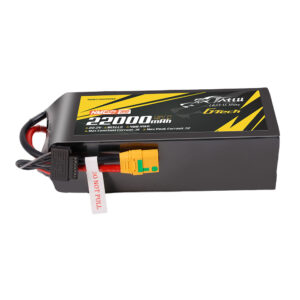
Range is energy, and energy is capacity times voltage. For a multirotor, most of that energy goes to holding the aircraft up, which is why range is poor past a point. For a VTOL, the energy goes to climbing and then to staying in the air efficiently, which is why it reaches much further. Either way, the pack has to be sized for the route with margin, and C-rating has to match the climb current. The method is in the UAV battery guide.
Release systems and the rest of the machine
The lifting part is half the job. A delivery drone also needs a way to carry and release the payload, and often a box that keeps it stable in flight. We stock release and logistics hardware under logistics systems, and the intelligent logistics platform we ship is the Skyexpress delivery system.
The unglamorous parts: weather and corridors
Delivery gets sold on the aircraft and decided by everything around it. Wind is the obvious one. A heavy payload in a gust needs margin you probably won’t have if you sized the aircraft to hover at 70 percent throttle. Heat is the quieter one, because a hot day thins the air and every propeller makes less thrust in thinner air, right when the motors are already working hardest.
Then there’s the route itself. You need somewhere to take off from, a path that keeps clear of people and property, and a place to put the payload down that a customer can actually reach. On long routes, that turns into questions about line of sight, comms range and what happens when the link drops. None of that is propulsion, but it decides whether a delivery drone is practical on a given route, and it’s worth answering before you buy the hardware.
One practical habit that saves trouble: fly the route empty before you fly it loaded. You’ll find the wind funnels, the dead spots and the awkward landing points without risking a payload. It also gives you a real energy figure for the route, which is far more useful than a datasheet estimate.
Pick your class, then spec it
Decide the payload first, not the airframe. Under 5kg, a light multirotor does it. 5 to 30kg, a heavier multirotor with real thrust margin. 30kg and up, a VTOL, because range on a hovering platform stops making sense. If you’re still mapping the job to hardware, the applications guide is the place to start.
Frequently asked questions
Multirotor or VTOL for delivery?
Multirotor below about 30kg and short range. VTOL above that, or whenever the route is long, because cruise is far more efficient than hovering, as our VTOL motor comparison explains.
What thrust margin should a delivery drone leave?
Plan to hover at half your available thrust or better, so a gust or a warm day does not push you to the limit.
How do I estimate range?
From energy. Work out the power the route needs, divide the pack energy by it, and keep a reserve. Multirotors lose range fast with weight; VTOLs hold it better. The pack method is in our battery sizing guide.
Do I need special props for heavy payloads?
Large, stiff carbon props, yes. At these weights a flexing blade costs efficiency and loads the hub badly.
What about the release mechanism?
It has to be deliberate and reliable. A release that can trigger on its own is the wrong release, whatever it costs.
Tell us the payload and the route, and we will tell you which class you are in and what it needs. The range is on our motor page, with pack sizing in the UAV battery guide.