
Heavy lift breaks all the usual shortcuts. On a small quad, you pick a motor first and sort the rest out later. Above about 25kg that stops working. The propulsion system, the pack and the airframe all get sized from the payload, and every kilogram you spend on motors is a kilogram you don’t get to lift.
Quick answer: Above about 25kg the shortcuts stop working: propulsion, pack and airframe all get sized from the payload. A hexacopter at 25kg all-up needs 50kg of thrust, so a little over 8kg per motor. An octocopter carrying 50kg needs about 12.5kg each, and a quad built for 100kg MTOW needs 50kg at every corner. That puts you near 50% hover throttle, which leaves authority to correct in a gust or mid-turn. 12S is fine for 25-35kg builds and 14S to 24S above that, and ESC margin has less slack here than anywhere else. Background is in our propulsion overview and the motor selection guide.
| Airframe | All-up weight | Total thrust | Per motor |
|---|---|---|---|
| Hexacopter | 25 kg | 50 kg | A little over 8 kg |
| Octocopter | 50 kg | 100 kg | About 12.5 kg |
| Quad | 100 kg MTOW | 200 kg | 50 kg at every corner |
| Voltage rule | 25-35 kg | Not applicable | 12S is enough |
| Voltage rule | Above 35 kg | Not applicable | 14S to 24S keeps current and heat down |
This is the sizing order we use on agricultural, cargo and manned builds, and here are the numbers that matter at each step.
Thrust per motor is the whole design
Hover needs thrust equal to all-up weight. Control needs margin on top of that. So the working rule is total thrust of about twice the all-up weight. That puts you at roughly 50% hover throttle, and it leaves enough authority to correct in a gust or mid-turn.
Divide that by the motor count. A hexacopter at 25kg all-up needs 50kg of thrust, so a little over 8kg per motor. An octocopter carrying 50kg needs about 12.5kg each. A quad built for 100kg MTOW needs 50kg at every corner. That’s a different class of hardware entirely.
Get the thrust per motor and the motor choice becomes a lookup instead of a guess. And the number of motors is the cheapest lever you’ve got, because adding two more arms drops the thrust each motor has to produce.
Cell count: where heavy lift separates from the rest
Big, low-KV motors turn big propellers. A 40-inch prop needs a slow motor to stay inside its efficient band, and slow means low KV or low voltage. Heavy lift goes both ways here: 29KV on 24S, or 60KV on 14S, and both can spin a similar rpm from very different hardware.
What voltage really decides is current for a given power. A 15kW propulsion unit on 24S pulls around 175A. The same power on 12S pulls around 350A, which doubles the copper, the connector size and the heat in every joint. That’s why the manned-aircraft end of the range runs 14S to 24S packs: the current stays manageable. Whatever you pick, it has to sit inside the ESC’s rated cell range.
The hardware we use at each class
25kg to 35kg all-up
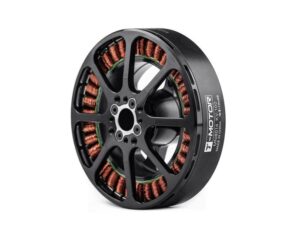
Agricultural spray drones and mid-size cargo. Typically 12S to 14S, 26- to 30-inch propellers, and motors like the P80 III KV100 or the MN1330 KV40. ESCs land in the 80A to 120A band.
50kg to 90kg all-up
Heavier agricultural platforms and industrial cargo. 14S, 32- to 36-inch propellers, and at this point matched sets make more sense than mixing parts. The U15XXL 29KV with the Thunder 300A 24S ESC is the combo we quote most at this weight.
100kg and above
Manned and heavy cargo. The VL1380 is rated for a 140 to 150kg MTOW quad, so you’ve got one motor per corner doing the work of a small propulsion system. At that size, prop stiffness and hub strength stop being small details. The VZ45x18 carbon propeller is built for exactly that.
ESC sizing has less slack here than anywhere else
On a small build an oversized ESC costs you a bit of money and weight. On a heavy lifter it costs nothing extra, because the ESC is a rounding error next to the pack. And an ESC sized too close is the single point of failure we see come back most on heavy builds.
Take the hover current off the thrust table, multiply by 1.5 to 2 for manoeuvres, then round up to the next standard rating. A motor hovering at 90A on a heavy platform wants a 200A ESC. That’s why the V200A 14S FOC ESC exists. On low-KV motors with big props, FOC earns its keep too, smoother low-rpm torque and less heat. We go through that in FOC vs standard ESCs.
Propeller, then pack, then wiring
Prop diameter follows the frame, pitch follows the job. Spray drones hover and work at low speed, so they want diameter. Cargo aircraft that have to cover distance want more pitch. Go past the manufacturer’s tested combinations and you’re off the thrust table. Then you’re testing instead of building.
The pack then has to deliver sustained current without sag. Two numbers matter: the continuous C-rating against your hover current, and the connector’s current rating. A 25C 22000mAh pack is rated at roughly 550A nominal, and that’s fine for a heavy lift build. The AS150 connector is usually where you hit the limit, well before the pack itself.
Last thing. Heavier propulsion hardware raises all-up weight, that raises the thrust requirement, and that raises hardware weight again. On heavy lift this loop converges slowly. Budget for one round of weight gain and re-check the thrust figure at the end rather than at the start.
Matched sets for the top of the range
Above about 50kg, a matched propulsion set takes out a whole class of risk, because the thrust table, the ESC and the prop pitch have already been checked against each other. The U15XXL 29KV combo bundles the motor, ESC and propeller. The thinking behind kits in general is in integrated UAV propulsion kits. Everything in this class sits under VTOL UAV power and propulsion systems.
Frequently asked questions
How much thrust per kilogram do I need?
Roughly twice all-up weight in total thrust, split across the motors. That lands you near 50% hover throttle with margin left for control.
Should a heavy lift drone run 12S or 24S?
Higher voltage keeps current, copper and heat down for the same power. 12S is fine for 25 to 35kg builds, 14S to 24S for anything heavier, which is the split in our motor selection guide.
Do I need FOC ESCs on a heavy platform?
They help. Smoother low-rpm torque and less heat matter more once the motor is big and the prop is heavy. A properly sized standard ESC still works, as we compare in the FOC versus standard ESC guide.
What limits payload more, motors or battery?
The battery most of the time. Pack mass grows with capacity, so past a point every extra cell spends its own energy lifting itself. Energy density caps endurance.
Can I add arms instead of bigger motors?
Often yes, and it is usually the cheaper way. More motors spread the same thrust requirement across more units, and you pay for it in frame mass and complexity.
Send us the all-up weight, the number of arms and the flight time you are chasing, and we will size the motor, ESC and propeller class around it. Motors and matched sets sit on our motor and propulsion page, with kit sizing in the propulsion kit guide.