
Ask ten builders what limits their flight time and eight of them will point straight at the battery. They’re half right. The pack sets the ceiling, sure, but the ceiling itself comes down to three numbers: voltage, capacity, and how hard you pull from the pack in a hover. Then there’s a fourth one almost nobody checks until a pack has already puffed. That’s the discharge rating.
Quick answer: Flight time is set by three numbers: voltage, capacity, and the current your aircraft pulls in a hover, with the discharge rating acting as a limit rather than a headline. A 12S pack sits at 44.4V, the 14S NEO Compact at 51.8V, the 18S packs reach 68.4V, and the high-voltage semi-solid 6S line runs at 22.8V instead of the usual 22.2V. Treat about 80% of rated capacity as usable, land at roughly 3.7V per cell, store at 3.8-3.85V, and size the C-rating to hover current plus margin. The arithmetic is in our battery sizing guide, and the rating itself in the C-rating guide.
| Cell count | Nominal voltage | Typical airframe | Hard limit to check |
|---|---|---|---|
| 6S LiPo | 22.2V | Trainers, small to mid multirotors | ESC and motor rated for 6S |
| 6S HV semi-solid | 22.8V | Endurance builds | Charger covers the HV voltage |
| 12S | 44.4V | Agricultural and heavy lift | ESC cell range and connectors |
| 14S NEO Compact | 51.8V | High-energy platforms | ESC rated to 14S |
| 18S | 68.4V | High-voltage platforms | Every part in the chain rated for it |
This is the page we send customers to when they ask, “what battery should I run?”. It walks through what each figure actually means, how to size a pack for a given payload, and which families we keep on the shelf for each job. If you’d rather just see the arithmetic in one worked example, skip down to the sizing walkthrough.
Voltage comes first
Cell count sets voltage, and voltage sets how fast a given KV motor can spin. A 12S pack sits at 44.4V nominal. The 14S NEO Compact packs sit at 51.8V, the 18S packs reach 68.4V, and the high-voltage semi-solid 6S line runs at 22.8V instead of the usual 22.2V.
More cells in series means lower current for the same power, and lower current means less heat in the wiring and slightly better efficiency. It also means every part downstream, the ESC, the connector, the charger, has to be rated for it. Raising the cell count without checking the ESC’s cell range is one of the most expensive mistakes we see come across the counter.
Two habits keep you out of trouble. Match the pack’s cell count to the ESC’s rated range, and re-read the motor’s thrust table at the voltage you’ll actually fly. A 170KV motor turns noticeably slower on 6S than on 12S, and every thrust figure moves with it.
Capacity, and the one formula that matters
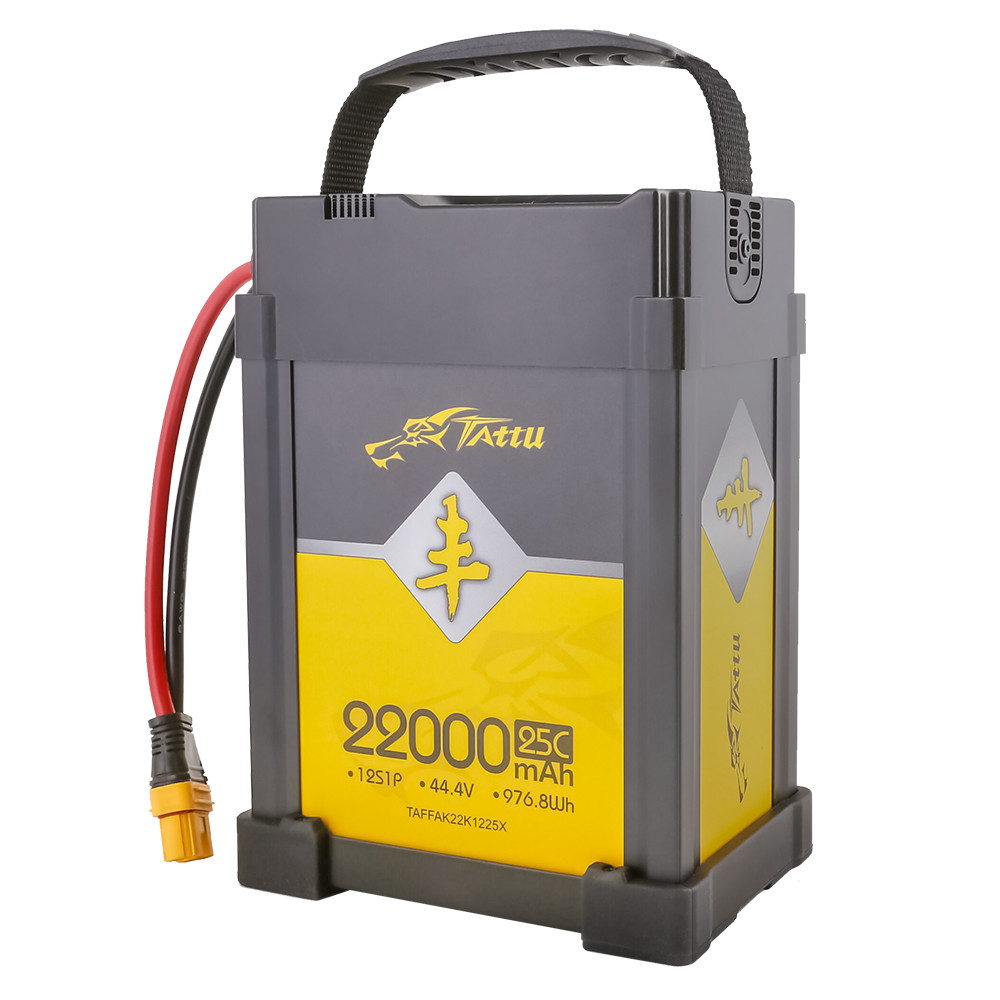
Capacity is quoted in mAh. Energy is what actually flies the aircraft, and energy is capacity × voltage, in watt-hours. A 22000mAh 12S pack holds roughly 976Wh. A 22000mAh 6S pack holds roughly 488Wh: the same mAh, half the energy, because there are half as many cells in series.
So when a customer says they’ve “moved to a bigger pack,” the first question is always the same: bigger in mAh, or bigger in watt-hours? That’s the question we get most often, and the two aren’t interchangeable. Only one of them adds flight time.
Flight time is a single division, and it should never assume an empty pack. On LiPo chemistry, usable capacity is about 80% of rated capacity, not the full number on the label.
Flight time (minutes) = usable capacity (Ah) × 60 ÷ hover current (A)
Take a 22000mAh 12S pack on a 25kg spray drone drawing 120A in the hover. Usable capacity is 22Ah × 0.8 = 17.6Ah, so 17.6 × 60 ÷ 120 gives you about 8.8 minutes. That’s the number to plan a spray route around, not the figure on the box.
The discharge rating is a limit, not a headline
The “C” figure is the maximum continuous current the pack is built to deliver, expressed as a multiple of its capacity. A 25C 22000mAh pack is therefore rated to roughly 550A continuous. On paper that looks enormous, and on most UAV builds it is, which is exactly why it gets ignored. And this is the one we see come back puffed.
The rating doesn’t tell you how the pack behaves at part load, which is where it spends almost all of a UAV flight, and it doesn’t tell you how much of that number survives 30°C inside a sealed battery bay. Treat the published figure as a ceiling, keep your hover current at half of it or less, and save the peak for the few seconds the peak actually lasts.
Chemistry, briefly
Nearly everything on a working UAV today is lithium polymer. The real choice now is where you want to sit on the energy-density curve: conventional LiPo, high-voltage LiPo, semi-solid state, or a smart pack with onboard management. We compare them properly in LiPo vs Li-Ion for drone batteries. Semi-solid state cells push energy density toward 300Wh/kg, while conventional LiPo stays cheaper and more forgiving of the occasional bad day.
The packs we keep on the shelf
Agricultural and heavy lift
These machines want capacity first, and a connector that can take a sustained load. The Tattu AGRI 22000mAh 12S and the AGRI 16000mAh 12S are the two we ship most often, with the G-Tech 6S 22000mAh and the Plus 1.0 Compact 16000mAh for builds that want the management board.
Long endurance, survey and inspection
Here energy density earns its price. The NEO Compact G330 36000mAh 14S, the NEO 30000mAh semi-solid 12S and the Tattu 4.0 30000mAh 14S cover the large end, and the Semi-solid State 300Wh/kg 22000mAh 6S suits lighter airframes that still need the range.
FPV
A different job entirely, with its own pack sizes and connectors. Everything lives under FPV batteries, and the range runs from tiny 1S packs up to 6S 120C race cells like the R-Line 1300mAh 6S 120C.
Sizing a pack, end to end
If you only remember one sequence, make it this: all-up weight, then hover current, then the flight time you actually need, then capacity, then cell count, then a C-rating sanity check. The worked arithmetic, with numbers for a 5kg, 10kg and 25kg machine, is in How to size a UAV battery for payload and flight time. A spray drone bends the rules a bit, with spray weight, pump draw and route length all in play, so we keep a dedicated walkthrough in the agricultural drone battery selection guide.
Charging and storage decide pack life
Two packs bought the same day and run on the same aircraft can differ by a hundred cycles, purely on how they were charged and stored. Storage voltage, charge rate and temperature account for most of it, and the habits that quietly cost you packs are covered in charging and storage. The kit we reach for most is the Tattu TA1000 for field work, the TA300 eight-channel for a fleet, and the iMars S100 for smaller packs. All of it sits under chargers and accessories.
Frequently asked questions
Does a bigger mAh pack always mean more flight time?
No. Flight time follows watt-hours, and it follows weight too. A heavier pack costs thrust, so past a certain point the extra capacity ends up carrying itself, which is the argument in our battery sizing guide.
Can I run a 12S pack on a 6S build?
Not unless every ESC and motor in the chain is rated for 12S. Voltage ratings are hard limits and do not bend. Compare the options in the high-voltage pack guide.
How low should I discharge a LiPo?
Land at about 3.7V per cell under load, which leaves roughly 20% in the pack. Treat 3.5V as an emergency floor, never a target. Storage practice is in our charging and storage guide.
Is a high C-rating worth paying for on a UAV?
Only up to your hover current plus a bit of margin. Past that you are buying a number, as the C-rating guide explains.
Not sure which pack fits your airframe? Send us the all-up weight, the cell count your ESCs will take and the flight time you are aiming for, and we will size the pack around it. The range is on our UAV battery page, with charging and storage practice in the charging guide.


Pingback: Drone Battery Charging and Storage: What Shortens Pack Life
Pingback: How to Size a UAV Battery for Payload and Flight Time
Pingback: UAV Applications Guide: Agriculture, Inspection and Survey
Pingback: Drone Delivery and Logistics: Payload Class Guide
Pingback: Agricultural Drone Setup: Motor, Propeller and Battery
Pingback: Thermal Inspection Drone Configurations