
Almost every motor enquiry in our inbox opens the same way: “I want more thrust.” Thrust is rarely the problem. Nine times out of ten the fault sits elsewhere in the chain — a motor that was actually fine, an ESC with no headroom, or a propeller that never appeared in that motor’s thrust table to begin with.
Quick answer: Spec a UAV motor in this order: all-up weight, thrust target, KV, then current, then propeller. Plan about 2x all-up weight in total thrust for a multirotor and 2.2-2.5x for agricultural or heavy-lift builds, keep ESC current 20% above measured peak, and only size from a thrust table published at your cell count. A 12kg and a 25kg machine can share a propeller but never the same motor or ESC. See our KV guide and the propulsion overview.
| Airframe | Typical class | Motors we fit | Thrust target |
|---|---|---|---|
| Camera / trainer multirotor | 1-4 kg AUW | MN2806 EVO KV650 | about 2x AUW |
| Mid-size multirotor | 6-12S, 4-12 kg | MN6007 II KV160 / KV320 | about 2x AUW |
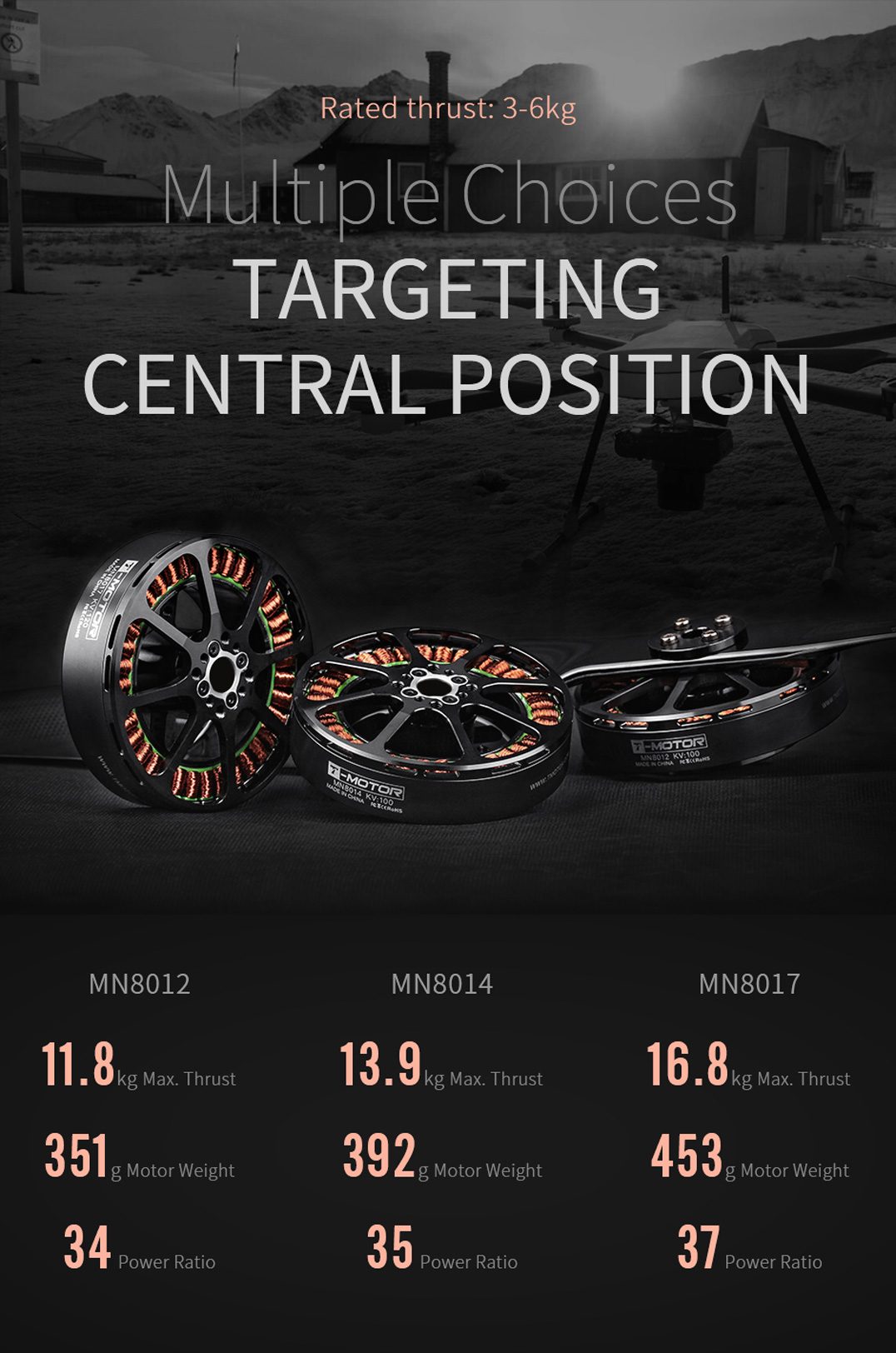
| Heavy lift | 25 kg class | MN8012 KV100 / MN8017 KV120 | 2.2-2.5x AUW |
| Very heavy lift | 45-100 kg | MN1005 V2.0 KV90 | 2.2-2.5x AUW |
| VTOL lift motor | 50-55 kg MTOW | VL1032, VL1028 at 28 kg per arm | about 2x at hover |
| Fixed wing | up to 65 kg MTOW | AT1040 130CC / AT2826 KV900 | meets cruise drag |
What follows is the order we use when we spec a propulsion set here in Xiamen, and the points where builds usually fall apart. None of it is exotic. It is just the sequence most people skip.
Start with the weight you have to lift
Before you look at a single motor, write down the all-up weight: airframe, battery, payload, camera, everything on the aircraft. For a multirotor, plan for total thrust of roughly twice that weight. For agricultural and other heavy machines go higher — 2.2 to 2.5 times is the safer target, so the aircraft can hover at part throttle in wind and still have climb authority left.
This one number decides more than any data sheet. A 12kg machine and a 25kg machine may spin the same propeller, but they will not use the same motor, and they certainly will not use the same ESC.
Then read KV, and only for what it says
KV is revolutions per minute per volt. A 170KV motor on a 12S pack (about 44.4V) turns at roughly 7,500rpm with no load. That is all the figure means. Low KV gives you torque and lets you swing a large propeller; high KV gives you rpm and suits small props and lower voltage.
The mistake we correct most often is choosing KV by feel — bigger number, more power. It is the opposite. On heavy lift you go lower in KV and higher in voltage, not the other way around.
Read the thrust table the way you fly, not the way you shop
Every motor we sell arrives with a thrust table measured at specific voltages and specific propellers. Shoppers read the top row, the 100% throttle peak thrust, and stop there. Builders read the middle.
Find the row where your target thrust appears at around half throttle. That is where efficiency and control authority are both at their best. If the numbers only work near full throttle, the motor is undersized and will run hot however impressive the peak figure looks.
Look at grams per watt at that hover point too. Two motors can make identical peak thrust and still differ by a quarter in hover efficiency. That quarter turns into minutes of flight time, and it is the difference pilots feel long before they can find it on a spec sheet.
Do the current maths before you open the ESC page
Two currents matter, hover and peak.
- Add hover current across all motors and make sure your battery’s continuous discharge rating clears it with margin.
- Take one motor’s peak current and give the ESC at least 20% headroom above it. More if you fly in a hot climate or at altitude.
- Match the ESC’s cell count to the pack. The ESC, not the motor, is usually the limiting part.
For industrial and agricultural work, FOC (field-oriented control) ESCs earn their price: smoother response near zero throttle, less acoustic noise, and better efficiency at part load. On a cost-driven build a standard ESC still does the job.
The propeller is not a free variable
Diameter sets how much air you move. Pitch sets how fast you move it. Swap to a propeller outside the motor’s measured table and both your thrust and current numbers become guesses. If field swaps matter to you — and on a working drone they always do — fit a quick-release adapter and stop carrying spare bolts.
What we put on the three main airframes
Multirotor and heavy lift
Flat-rotor motors built for efficiency first. For 6–12S mid-size rigs the MN6007 II (KV160/KV320) is a sensible start. Step up to the MN8012 KV100 or MN8017 KV120 on larger 12S machines, and to the MN1005 V2.0 KV90 when payload really bites. Camera and trainer builds can start as low as the Antigravity MN2806 EVO KV650.
Gimbals and stabilised payloads
These want low KV and high torque rather than thrust. The GB2208 KV128 and GB4106 KV53 cover small camera heads. The GB36-1 KV50 and GB54-2 KV26 handle heavier ones.
VTOL
Lift motors have to make thrust quickly and then hand over to the wing in cruise. The V505 KV260 and V602 KV180 are the common mid-size choices. The V10 KV160 and the 24S V13L KV65 cover the large end. In the high-thrust VL line the model number roughly states the payload class: VL1028 at around 28kg per arm, VL1032 for 50–55kg MTOW, up to VL1380 for 140–150kg MTOW.
Long-shaft AT motors are the tractor option that keeps the propeller clear of the wing: AT4120, AT4125, AT5230A 30CC KV200 and the large AT8025 70CC.
Fixed wing
Size the motor to the airframe, from foam trainers (AT2308) and 3D/F3A ships (AT2826 KV900/KV1100) through to the big gas-class equivalents (AT1040 130CC, about 65kg maximum take-off weight).
The 90% throttle story
A customer once sent us a hexacopter that, in his words, “just flies badly.” It hovered, but only around full throttle, and every motor came down too hot to hold. Nothing was broken. The motors were simply one class too small for the weight, so the ESCs spent the entire flight at maximum current. We moved them up one stator size. The same airframe gained roughly four minutes and ran cool. Wrong motor, correct everything else.
The five things we correct most often
- Buying on peak thrust and ignoring hover efficiency.
- Under-sizing the ESC. Twenty per cent headroom is a floor, not an aim.
- Fitting a propeller that never appeared in the motor’s thrust table.
- Hovering at 90% throttle, the classic sign of an undersized motor.
- Forgetting that hover current multiplied by motor count can outrun a battery that looked generous on paper.
When to stop matching and buy a set
If you would rather not do this arithmetic, an integrated set does it for you, with motor, ESC and propeller measured together and shipped matched: the 505-X and 705-X kits, the A10 modular kit, and the AirGear combos. If you are weighing a matched set against separate parts, we wrote that decision up separately: integrated UAV propulsion kits, and when they win.
Frequently asked questions
Does a higher KV mean more power?
No. KV only sets rpm per volt. Torque and thrust come from stator size and the propeller, so a low-KV motor with a big prop often makes more useful thrust than a high-KV motor with a small one. Our KV guide has the detail.
How much ESC headroom do I need?
At least 20% above measured peak current, and more in heat or at altitude. The calculation is in our ESC and propeller matching guide.
Can I run a 12S motor on 6S?
Yes, at lower rpm and lower thrust. Check the ESC cell range and re-read the thrust table at that voltage before you commit.
Do I really need FOC ESCs?
Not on a hobby build. On industrial and agricultural machines the smoother low-throttle response and lower noise are worth the money.
Not sure which motor fits your build? Send us the all-up weight, the propeller you want to run and your cell count, and we will size the whole power train. The range is on our UAV motor page, with documentation on the T-Motor download page.


Pingback: Integrated UAV Propulsion Kits: Matched Motor, ESC & Prop
Pingback: UAV ESC & Propeller Matching Guide: Size the ESC Right
Uncooke
30 Oct 2026Металлический прокат служит основой в строительства, поскольку гарантирует долговечность изделий.
Он масштабно применяется в строительстве инфраструктуры, а также в выпуске техники.
Благодаря многообразию видов материал обеспечивает возможность выполнять сложные архитектурные решения.
купить металлопрокат днепр
Также металлопрокат востребован для изготовления техники и различных сегментов хозяйства.
В конечном счёте прокат служит базовым материалом для стабильного функционирования инфраструктуры.