
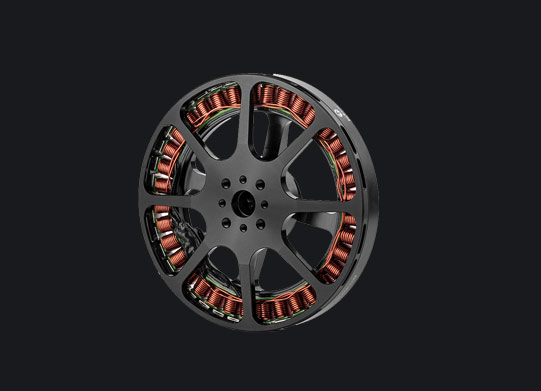
Every propulsion question we get lands in the same spot: a motor, an ESC and a propeller that have to work together, at one voltage, on an aircraft of one weight. Move one of the three and the other two move with it.
Quick answer: Start from thrust per motor, not from a model number. An aircraft needs roughly twice its all-up weight in total thrust to hover with control authority, so a 25kg machine needs about 50kg, which on a hexacopter is a little over 8kg per motor at the voltage you actually fly. KV behaves like a gear ratio: a 100KV motor spins about 4,440rpm on 12S and half that on 6S, and a motor rated 12kg maximum thrust on 12S may only reach 9kg on 8S. Leave roughly 1.5 to 2 times hover current on the ESC. The long form is in our motor selection guide and the ESC matching guide.
| Airframe | Thrust target | Worked example | Go deeper in |
|---|---|---|---|
| Multirotor | About 2x all-up weight | 25 kg hexacopter: a little over 8 kg per motor | Motor selection guide |
| Agricultural sprayer | 2.2-2.5x | 25 kg machine: 55-62 kg total thrust | Agricultural setup guide |
| VTOL | About 2x at hover, then hand over to the wing | Lift motors sized for hover only | VTOL versus multirotor motors |
| Heavy lift | 2.2-2.5x | 45-100 kg: prop diameter and voltage decide | Heavy lift motor guide |
| Fixed wing | Enough to meet cruise drag | Size to the airframe, not to a thrust multiple | Fixed-wing motor sizing |
Think of this page as the index. It walks through the numbers that actually decide a build, then sends you to the deeper articles for each family: multirotor, VTOL, fixed-wing, agricultural and heavy lift. Already know your all-up weight and just want the arithmetic? Jump to the sizing order further down.
Start from thrust per motor, not from a model number
Thrust is the one figure that decides whether a build flies. An aircraft needs roughly twice its all-up weight in total thrust to hover with control authority to spare, so a 25kg machine needs about 50kg of thrust, split across however many motors it carries. A hexacopter hauling 25kg therefore wants a little over 8kg per motor at the voltage you’ll actually fly.
Motor model numbers won’t tell you that. Thrust tables will. That’s why we never size a propulsion system off a catalogue headline. We start from payload, then hunt for the motor whose table clears the requirement with margin. This is the one we see come back most often, a part picked by headline number instead of by the table.
KV is a gear ratio, not a power rating
KV tells you how fast a motor turns per volt under no load. A 100KV motor spins at roughly 4,440rpm on a 12S pack, and half that on 6S. Lower KV suits bigger propellers and higher voltage. Higher KV suits smaller propellers and lower voltage. A high-KV motor isn’t “stronger” than a low-KV one, it’s just geared differently, and pair it with the wrong prop and you’re burning current as heat.
The full walk-through, worked examples across the MN, VL and AT families included, lives in UAV motor KV explained.
Read the thrust table at the voltage you fly
Manufacturers publish thrust in grams or kilograms against throttle, sometimes against current too, and usually for one or two cell counts. Read the row that matches your pack. A motor listed at 12kg maximum thrust on 12S may only reach 9kg on 8S. If your airframe needs 8kg per motor, you’re hovering at 90% throttle, a setup that runs hot and has nothing left for a gust.
Two rules keep this honest. Hover at no more than about half the published maximum thrust, and check the current figure in that hover row. That number sizes your ESC.
Sizing the ESC around peak current, not hover current
Hover current is what the ESC lives with. Peak current is what it has to survive. Take the hover current from the thrust table, multiply by roughly 1.5 to 2 for aggressive manoeuvres, then pick the next standard rating above it. A motor drawing 60A in the hover on a working drone wants a 100A to 120A ESC, not a 60A one.
Cell count is a hard limit too. A 24S pack on a 14S-rated ESC ends the flight early, and it ends it expensively. The differences between control strategies, and which loads actually need field-oriented control, are covered in FOC vs standard ESCs for UAVs, and the practical matching walk-through is in matching an ESC to a motor and propeller.
The propeller decides most of it
Diameter sets thrust, pitch sets airspeed, and both set the current the motor draws. A larger prop on the same motor pulls more current for more thrust. A higher-pitch prop trades climb for duration. On large airframes stiffness matters as much as size, because a flexible blade that flutters at a resonant rpm loses efficiency and starts eating hubs. We compare the two materials properly in carbon fibre vs polymer UAV propellers.
Which family for which airframe
Multirotor and industrial drones
Efficiency at hover is the goal here. The MN Antigravity line is where most builds start, and the MN8014 KV100 is the motor we quote most often for mid-size airframes. The whole family sits under multi-rotor UAV motors.
VTOL
VTOL motors spend their life doing two different jobs, hover and transition, often with folding props and quick-lock mounts. The VL8022 KV170 and the larger VL8018 KV180 cover that work. The trade-offs are in VTOL vs multirotor motors.
Fixed-wing
Here the propeller is sized for cruise, not hover, and the motor runs at a very different point on its curve. Sizing starts from wing loading. See fixed-wing motor sizing.
Agricultural and heavy lift
Payload first, current second, weight third. The U15XXL 29KV combo and the VL1380 sit at the top of that range. The reasoning behind each class is in heavy lift drone motors.
Matched sets versus buying separately
A matched kit takes the guesswork out, because the thrust table, the ESC margin and the prop pitch have already been checked against each other. The X-series and the modular A-series are the two we ship most, and the case for each is set out in integrated UAV propulsion kits. Buying separately is still the right move when you’re tuning a proven airframe or replacing a single part. The workflow for that is in how to choose a brushless motor for a UAV.
The order to work in
All-up weight, then thrust per motor, then cell count, then the thrust table at that voltage, then hover current, then ESC rating, then propeller diameter and pitch, then the C-rating sanity check on the pack. Work in that order and the parts stop fighting each other. Work in any other order and you’ll normally end up replacing the ESC.
Frequently asked questions
Do I need FOC or a standard ESC?
FOC pays off on large, low-KV motors with big props, where smooth torque at low rpm and lower heat matter. For small, fast props a standard ESC is cheaper and works fine, which is the comparison in our FOC versus standard ESC guide.
Can I run a higher cell count for more thrust?
Only if the ESC, the motor and the connectors are all rated for it. More voltage turns the prop faster and draws more current, so ESC margin shrinks as cell count climbs.
Is a bigger propeller always better?
No. Bigger props give more thrust per watt, but they demand more current and clearance, and on a frame that cannot swing them they cost efficiency, as our propeller comparison shows.
Why does my motor run hot at hover?
Almost always the wrong propeller for the KV and voltage, which pushes the motor past its efficient band. Re-read the thrust table at your actual cell count before changing anything else.
What margin should I leave on the ESC?
Roughly 1.5 to 2 times hover current, then round up to the next standard rating.
Tell us the all-up weight, the frame layout and the flight time you need, and we will match the motor, ESC and propeller around it. The range is on our motor and propulsion page, and matched sets are covered in the propulsion kit guide.


Pingback: Thermal Inspection Drone Configurations
Pingback: Drone Power Line Inspection: Payload and Endurance Setup
Pingback: FOC vs Standard ESCs for UAVs: Which One Your Build Needs
Pingback: UAV Applications Guide: Agriculture, Inspection and Survey
Pingback: Drone Delivery and Logistics: Payload Class Guide